THE WOW! SIGNAL
In 1977 an Ohio radio telescope recorded a strong, narrow radio burst from deep space that lasted 72 seconds and never returned. An astronomer circled it and wrote 'Wow!'
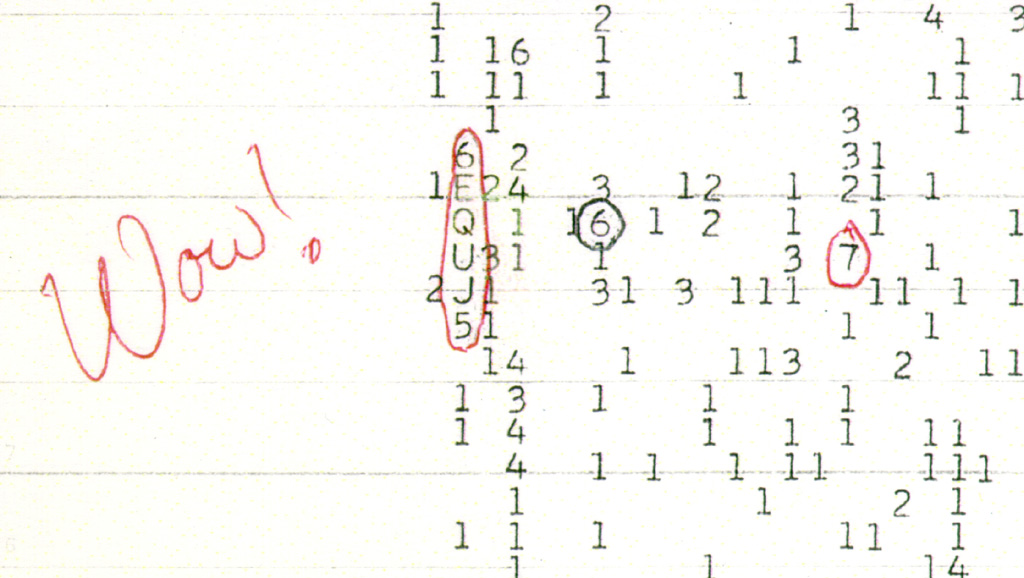

On August 15, 1977, the Big Ear radio telescope at Ohio State University recorded a strong, narrow radio signal while running a search for extraterrestrial intelligence. The signal lasted about 72 seconds, the exact time it would take a fixed point in the sky to pass through the telescope's beam, and came from the direction of the constellation Sagittarius. It has never been detected again [1].
The astronomer Jerry Ehman reviewed the printout days later. The telescope encoded signal strength as letters and numbers, and one column read 6EQUJ5, far above the background. Ehman circled it in red and wrote "Wow!" in the margin, which gave the event its name [1][2]. The frequency sat near 1420 megahertz, the emission line of neutral hydrogen, a band that radio astronomers had long argued an alien transmitter might choose because it is universal and is protected from terrestrial interference.
The signal has resisted explanation. It was narrowband and strong, which points away from most natural sources, but it appeared only once. A 2001 follow-up search with the Very Large Array found nothing at the position [3]. In 2017 Antonio Paris proposed that hydrogen clouds around two passing comets produced it [4]. Big Ear team members and other astronomers rejected that account, noting the comets were not in the beam at the time and that such clouds do not radiate a sharp 1420-megahertz line.
What remains is a single, strong, unrepeated detection. Science treats a one-time event as a candidate, not a result, because nothing about it can be confirmed by a second look. The Wow! signal stays officially unexplained, neither demonstrated to be artificial nor traced to a known natural cause.
- [01] Ehman, J.R. (1998, rev. 2007). The Big Ear Wow! Signal: What We Know and Don't Know About It After 20 Years. North American AstroPhysical Observatory.
- [02] Kraus, J. (1979). We Wait and Wonder. Cosmic Search 1(3). The Big Ear director on the detection.
- [03] Gray, R.H. & Marvel, K.B. (2001). A VLA Search for the Ohio State 'Wow' Signal. Astrophysical Journal 546(2), 1171-1177. A non-detection in follow-up.
- [04] Paris, A. (2017). Hydrogen Clouds from Comets 266P/Christensen and P/2008 Y2 (Gibbs) as a Source of the 1977 'Wow' Signal. Journal of the Washington Academy of Sciences. The comet hypothesis.
A single unrepeated signal invites strong readings in every direction. Each has a traceable origin and a documented response. They are laid out in full so you can weigh them yourself.
An extraterrestrial transmission
The strongest claim points to the frequency. At the hydrogen line that SETI researchers had named as the natural choice for an interstellar beacon, the signal was narrow and strong like an engineered carrier, and its 72-second profile matched a fixed celestial source [1]. The response: the event never repeated, decades of targeted searches have found nothing at that spot, and a result observed once on one instrument cannot be confirmed, which is the line between a candidate and a discovery.
A comet hydrogen cloud
Antonio Paris argued in 2017 that hydrogen around two comets passing through the field produced the burst [3]. Astronomers rejected the model on several grounds: the comets were not within the telescope's beam at the recorded time, neutral hydrogen clouds emit a broad signal rather than the sharp narrowband spike that was seen, and the proposed re-detections did not hold up.
Earth-origin interference or a satellite
A mundane reading attributes the signal to a reflection, an aircraft, or a classified satellite near the protected hydrogen band. Working against it, the Big Ear data show the source tracking with the stars rather than with the ground, which is hard to reconcile with a local emitter, though a one-time event leaves room that no later test can close.
- [01] Gray, R.H. (2012). The Elusive Wow. Palmer Square Press. The case for taking the signal seriously as a SETI candidate.
- [02] Ehman, J.R. (2007). Notes on the artificial-signal interpretation and the absence of a repeat detection.
- [03] Paris, A. (2017). The comet hypothesis, Journal of the Washington Academy of Sciences.
INFORMAL READER POLL, NOT DATA. WHICH EXPLANATION DO YOU FIND MOST CREDIBLE?