WATER MEMORY
A respected French immunologist published a result in Nature saying water remembers molecules that are no longer in it. Nature sent a magician to his lab. The effect disappeared, and the argument never did.
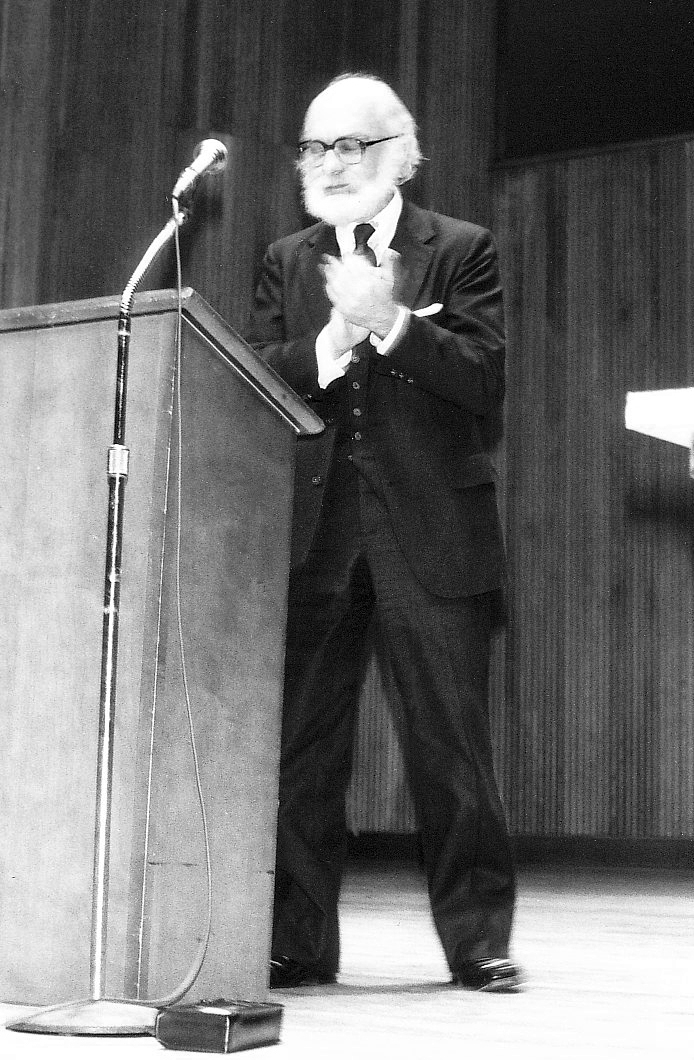

On June 30, 1988, Nature published a paper from Jacques Benveniste's laboratory at INSERM Unit 200 in Clamart, France [1]. It reported that an antibody solution, diluted so far that not a single molecule of the original substance could remain, still triggered a measurable response in human basophils, a type of white blood cell. The dilutions ran past 10 to the power of 120, far beyond the point where Avogadro's number says the last molecule is gone. If the result held, water carried something after the substance was removed, and the theoretical basis of homeopathy had an experimental leg.
Nature's editor, John Maddox, did something unusual. He published the paper with an editorial reservation printed alongside it, stating that there was no physical basis for the claim, and he made publication conditional on allowing an investigating team into the lab. In July 1988 that team arrived: Maddox himself, the magician and fraud investigator James Randi, and Walter Stewart, a scientific misconduct researcher from the National Institutes of Health.
They spent five days. The lab reproduced the effect while the experimenters knew which tubes were which. Then the team blinded the samples, coded the labels, and taped the code to the ceiling in a sealed envelope. Under those conditions the effect vanished. The team's report, published in Nature four weeks later, concluded that the data had been selectively interpreted, that the experimental design was insufficiently blinded, and that the claim was a delusion rather than a fraud [2]. It also noted that two of the paper's coauthors had salaries paid by Boiron, a homeopathic pharmaceutical company, a fact that had not appeared in the paper.
Benveniste never retracted. He lost his INSERM funding and spent the rest of his career on what he called digital biology, arguing that a molecule's biological activity could be recorded as an electromagnetic signal and replayed into plain water, even transmitted over a phone line or the internet. In 2006 a team led by Wayne Jonas, working with funding from the United States Defense Advanced Research Projects Agency and with Benveniste's own protocols, published its attempt to reproduce the digital effect. It found nothing [3]. Benveniste died in 2004. The clinical question ran in parallel and reached the same place: a 2005 Lancet analysis comparing homeopathy trials with matched conventional trials concluded the homeopathy effects were compatible with placebo [4].
The mainstream account is that the original result was real as an observation and unreal as a physical effect. Unblinded technicians counting cells under a microscope, deciding which fields to score, produced the pattern they expected, and the pattern went away the moment they could not know which sample was which.
- [01] Davenas, E. et al. (1988). Human basophil degranulation triggered by very dilute antiserum against IgE. Nature 333, 816-818.
- [02] Maddox, J., Randi, J. & Stewart, W.W. (1988). High-dilution experiments a delusion. Nature 334, 287-290.
- [03] Jonas, W.B. et al. (2006). Can specific biological signals be digitized? The FASEB Journal 20, 23-28. A funded attempt to replicate Benveniste's later digital biology claims.
- [04] Shang, A. et al. (2005). Are the clinical effects of homoeopathy placebo effects? The Lancet 366, 726-732.
A Nobel laureate revived the claim two decades after Nature buried it, which is why this file is still open. Each claim has a traceable origin and a documented response. They are laid out in full so you can weigh them yourself.
The effect is real and has been replicated
The strongest evidence for the defense is not Benveniste's. In 2004 Madeleine Ennis of Queen's University Belfast, who set out to disprove the claim, published a multi-laboratory study reporting that ultra-high dilutions of histamine still modulated basophil activation, with several of the participating labs finding the effect [2]. Supporters treat this as independent confirmation by a hostile witness. The response came from a test built on her own protocol: a BBC Horizon program in 2002 ran the experiment under strict blinding, with James Randi's million-dollar challenge on the line and independent oversight, and found nothing [3]. Ennis herself disputed aspects of how that test was run, which is where the matter stands.
The investigation was theater, not science
Michel Schiff and others in Benveniste's circle argued that sending a magician into a working immunology lab, taping codes to the ceiling, and publishing a verdict within a month was designed to end a career rather than test a hypothesis [1]. Randi was not a biologist. The team's five-day visit was not a replication study. There is something to this, and Nature's own conduct was unprecedented by any standard. What it does not do is rescue the result. The team did not need to be biologists to notice that the effect appeared when the technicians knew the tubes and vanished when they did not, and no subsequent properly blinded study has recovered it.
It is an unexplained anomaly, not a settled error
Luc Montagnier, who shared the 2008 Nobel Prize for identifying HIV, published work in 2009 claiming that highly diluted DNA sequences emit measurable electromagnetic signals, and said publicly that Benveniste had been treated unjustly [4]. That gives the claim a credential nothing else in this file has. Against it stands the venue and the method: the paper appeared in a journal on whose board Montagnier sat, moved from submission to acceptance in days, and has not been independently reproduced. A Nobel Prize is evidence about a person, not about a result, and the physics objection has never moved. Liquid water's hydrogen bond network rearranges itself in about a picosecond, which leaves nothing for a memory to be written on.
- [01] Schiff, M. (1995). The Memory of Water. Thorsons. Written from inside Benveniste's circle.
- [02] Ennis, M. et al. (2004). Histamine dilutions modulate basophil activation. Inflammation Research 53, 181-188. A multi-laboratory report of a positive result.
- [03] BBC Horizon (2002). Homeopathy: The Test. A blinded trial run with Ennis's protocol under James Randi's million dollar challenge, which found no effect.
- [04] Montagnier, L. et al. (2009). Electromagnetic signals are produced by aqueous nanostructures derived from bacterial DNA sequences. Interdisciplinary Sciences 1, 81-90.
INFORMAL READER POLL, NOT DATA. WHICH EXPLANATION DO YOU FIND MOST CREDIBLE?