THE LOSS OF USS CYCLOPS
In March 1918 the Navy collier Cyclops left Barbados for Baltimore with 306 people aboard and about 10,800 tons of manganese ore. She never sent a distress call, and no wreckage has ever been found. Twenty-three years later two of her sister ships vanished the same way.
_-_19-N-13451.jpg)
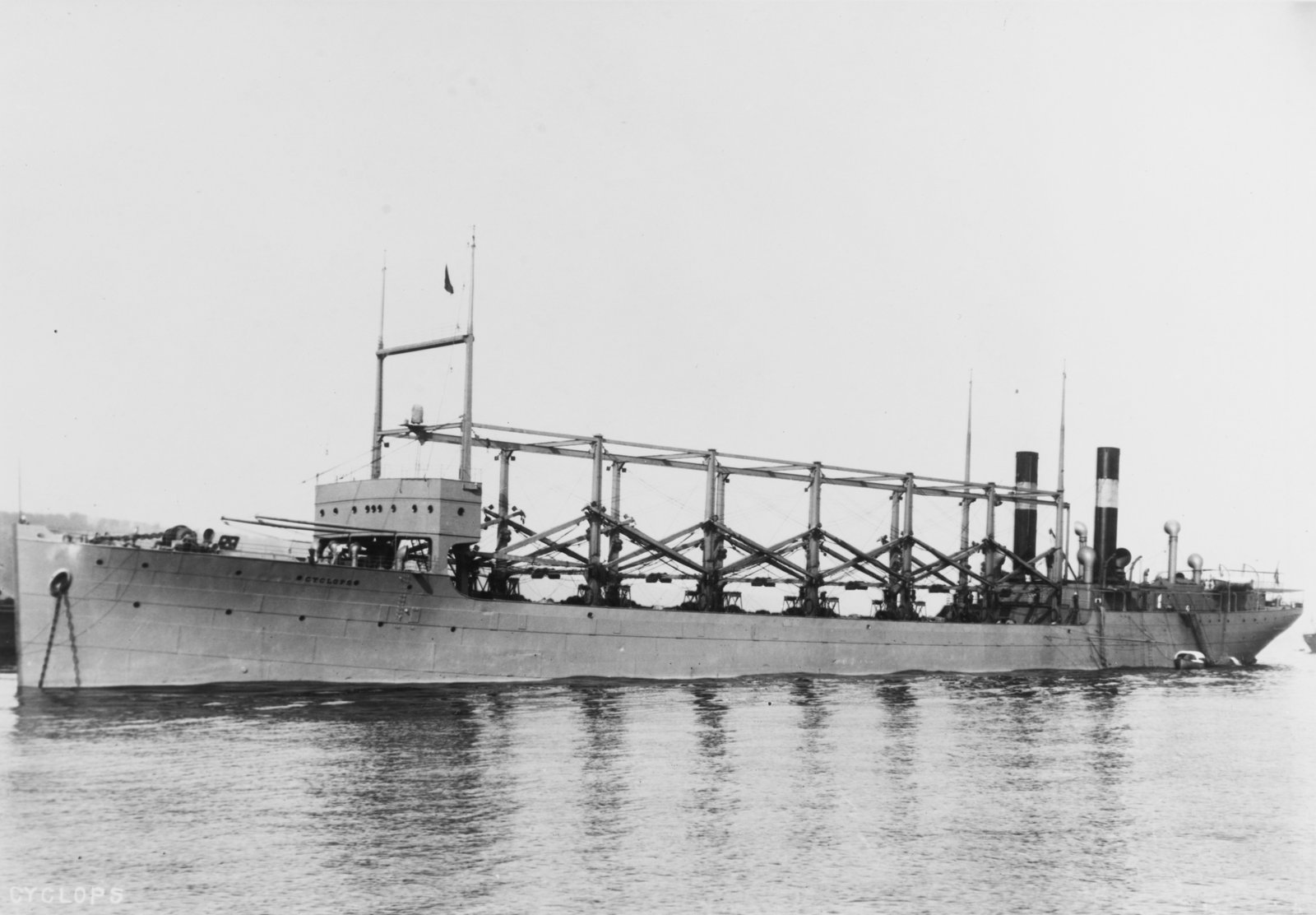
USS Cyclops was a 540-foot fleet collier, launched by William Cramp and Sons in Philadelphia in 1910 and commissioned into the Navy on May 1, 1917, a month after the United States entered the First World War. Her job was hauling coal to the fleet. On her last voyage she carried something heavier: about 10,800 long tons of manganese ore loaded in Brazil, bound for American steel mills [1].
She left Rio de Janeiro in mid-February 1918, called at Bahia, and then made an unscheduled stop at Barbados, where she took on coal and supplies. She sailed from Barbados on March 4 for Baltimore, due March 13. She never arrived. There was no distress call and no wreckage, and no body was ever recovered. On June 1, 1918, Assistant Secretary of the Navy Franklin D. Roosevelt declared the ship lost with all hands. The Navy's count is 306 crew and passengers; other tallies of the manifest reach 309 [1][2]. It remains one of the largest losses of life in Navy history outside combat.
Two facts about her condition shape every explanation since. She was running on one engine, because a cracked cylinder had put the starboard engine out of service, which held her to about 10 knots. And the ore load was heavier than a collier of her design normally carried [2].
The Navy's position: an unexpected storm
The Naval History and Heritage Command's own summary is that Cyclops "probably sank in an unexpected storm," while stating plainly that the cause is not known [1]. A violent storm did sweep the Virginia Capes on March 10, inside the window when she should have been approaching. A heavily loaded ship on one engine would have had little margin.
Structural failure
Rear Admiral George van Deurs proposed a mechanism that fits the silence. Colliers of the Cyclops class carried their loads in long open holds braced by longitudinal I-beams, and van Deurs argued that years of coal and seawater had corroded those beams. In a sea with waves spaced so that the bow and stern rode on crests while the middle sat in a trough, a dense ore cargo concentrated amidships could break the hull in two fast enough to prevent any radio call [4]. Captain Lawrence Brennan, an admiralty lawyer writing for the Naval Historical Foundation in 2013, describes the likeliest cause as several of these factors acting together: overloading, ore stowage, water ingress and lost stability [2].
Cargo shift
A 2009 BBC Radio 4 program put the question to a Lloyd's specialist, who pointed to the ore itself. Manganese ore is dense enough to shift inside a hold in a heavy roll, and wet ore can turn into a slurry that moves like a liquid. With hatches covered only by canvas, water reaching the cargo would have made a shift more likely, and a sudden list could have taken the ship over before anyone reached the radio room [4].
The sister ships
The detail most often left out of retellings carries the most weight for the structural reading. Cyclops had sister colliers, and the Navy sold two of them in 1941 for the bauxite trade. Proteus sailed from St. Thomas in the Virgin Islands for Portland, Maine, on November 23, 1941, with 58 aboard. Nereus followed the same route on December 10 with 61. Both carried bauxite, the ore of aluminum. Neither was seen again, and no German U-boat claimed either ship [3][4]. Three ships of one class, each lost without a call while carrying dense ore, points toward something in the design. It falls short of proof, since bauxite is a different cargo from manganese ore and both 1941 losses happened in wartime waters.
- [01] Naval History and Heritage Command, Dictionary of American Naval Fighting Ships, entry for Cyclops (Fleet Collier No. 4).
- [02] Brennan, L.B., Capt., JAGC, USN (Ret.) (2013). The Unanswered Loss of USS Cyclops, March 1918. Naval Historical Foundation.
- [03] Barrash, M.W. (2010). U.S.S. Cyclops. Heritage Books.
- [04] USS Cyclops, Wikipedia, cross-referenced against the NHHC entry and the van Deurs and BBC Radio 4 (2009) accounts it cites.
A ship that vanishes in wartime with a German-born captain was always going to draw suspicion, and in 1918 it drew it from inside the government. The claims below are the ones with a documented starting point.
The captain and the consul's telegram
The commanding officer, Lieutenant Commander George W. Worley, had been born Johan Frederick Wichmann in Sandstedt, Hanover. He jumped ship in San Francisco as a young man, later changed his name, and commanded merchant vessels before Cyclops [1]. On April 2, 1918, after the ship was overdue, the U.S. consul at Barbados, Charles Ludlow Livingston, cabled the Secretary of State. He reported that Worley had bought far more coal and supplies than the run to Baltimore required, that crew members had German names, that Worley was known locally by a slur for Germans, and that he suspected pro-German sympathies. He named a passenger as well: Alfred Gottschalk, the U.S. consul-general at Rio de Janeiro, whom he believed shared them [2].
The suggestion that followed was defection or sabotage, Cyclops steered to a German port or scuttled on purpose with her strategic cargo. Manganese is an alloying metal for hard steel, which gave the theory a wartime motive. Nothing ever surfaced to support it. No German port received the ship, no crewman reappeared, and postwar German records gave no sign of her. Barrash's study devotes much of its length to Worley and sets the accounts that damn him beside the ones that defend him [1].
Sunk by a U-boat or a mine
Wartime losses in the Atlantic were common, and an enemy submarine was the obvious suspect in 1918. The trouble is the paperwork. The German navy denied any involvement after the war, and its records list no sinking that matches Cyclops [2]. The same silence covers Proteus and Nereus in 1941: no U-boat claimed either one, although the British Admiralty suspected sabotage at the time because the two losses were so alike.
The Bermuda Triangle
Cyclops is now one of the most cited cases in Bermuda Triangle literature, but that framing arrived decades after the fact. The phrase itself comes from a February 1964 article in Argosy by Vincent Gaddis [3]. The Triangle explanation adds no evidence of its own to the record: it groups the loss with others in the same broad stretch of ocean and attributes the pattern to the region. What is particular to Cyclops, the engine, the ore and the sister ships, is all in the Navy's own record.
A wreck that was not found
In 2024 a website published a claim that the wreck had been located at about 1,300 feet. No maritime archaeologist has corroborated it, and the Navy has not confirmed it. As of October 2026 no discovery of Cyclops has been verified.
- [01] Barrash, M.W. (2010). U.S.S. Cyclops. Heritage Books.
- [02] USS Cyclops, Wikipedia, cross-referenced against the consular telegram of April 2, 1918 as quoted in Navy and State Department accounts.
- [03] Gaddis, V. (1964). The Deadly Bermuda Triangle. Argosy, February 1964.
INFORMAL READER POLL, NOT DATA. WHICH EXPLANATION DO YOU FIND MOST CREDIBLE?