THE TUNGUSKA EVENT
An explosion over Siberia in 1908 flattened 2,150 square kilometers of forest and left no crater. The cause is still argued.
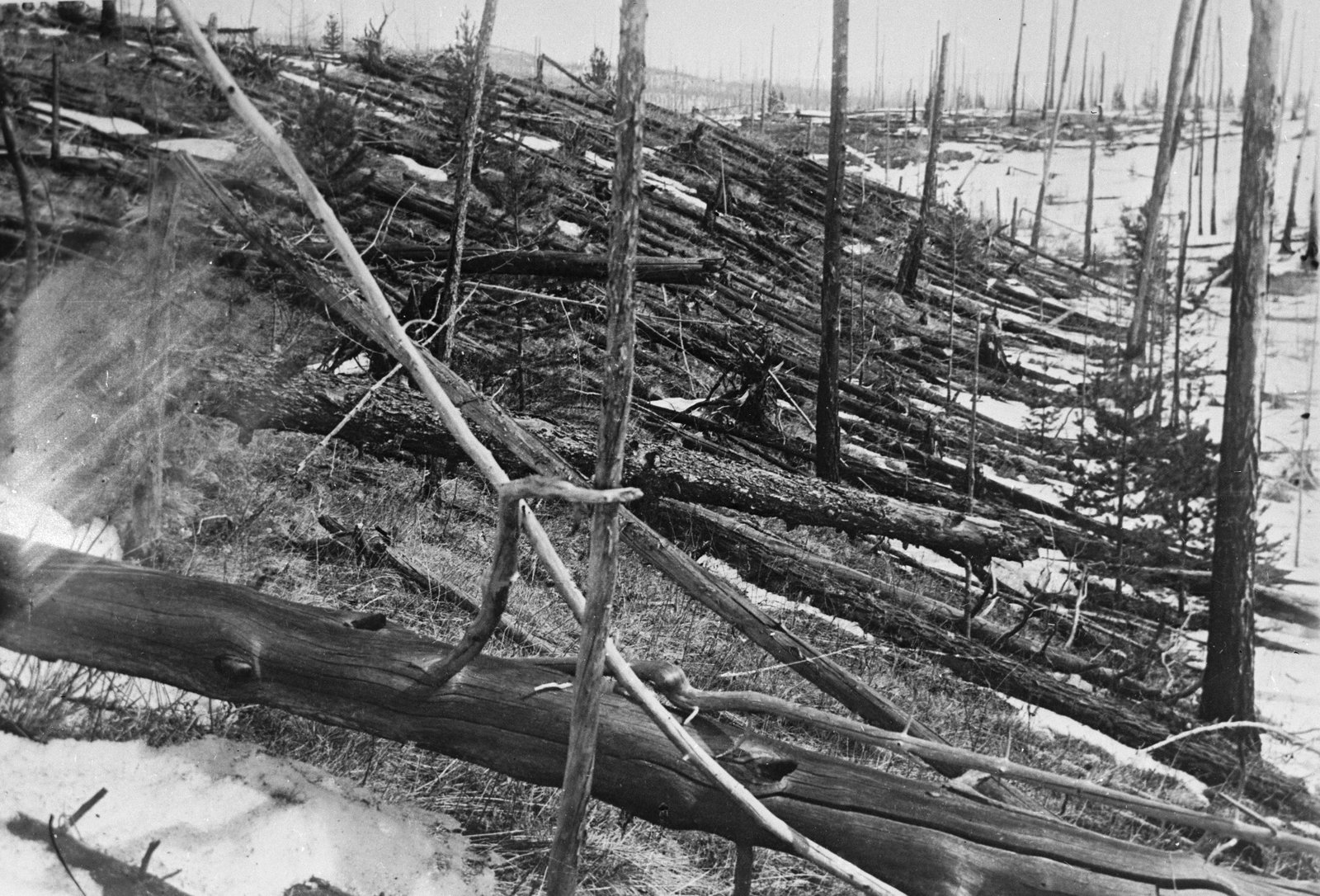

At about 7:17 in the morning on June 30, 1908, something detonated in the sky above the Podkamennaya Tunguska River in central Siberia, near 60.886°N, 101.894°E. It knocked down an estimated 80 million trees across roughly 2,150 square kilometers. It left no crater, and no one has ever recovered a confirmed fragment of the object.
No scientist reached the site for 19 years. The First World War and the Russian Revolution kept any expedition away until 1927, when the Soviet mineralogist Leonid Kulik led the first survey [1]. Kulik expected a meteorite crater he could mine for iron. He found trees flattened in a radial pattern pointing outward across about 50 kilometers, and at the center a grove still upright but stripped of branches and bark. No crater, no large meteorite. The pattern matched an explosion in the air, not a ground strike [1].
The closest eyewitness account came from S. Semenov at the Vanavara trading post, about 65 kilometers away. He described the northern sky splitting in fire, a wave of heat, and a shock that threw him off his porch. Seismographs registered the event across Eurasia at roughly magnitude 5. Barographs in Britain recorded a pressure wave that circled the planet, and for several nights the skies over Europe and Asia glowed bright enough to read newsprint outdoors at midnight [1].
Most researchers attribute the event to the airburst of a stony asteroid or comet fragment roughly 50 to 60 meters across, exploding 5 to 10 kilometers up as atmospheric pressure tore it apart [2][3]. Energy estimates range from 3 to 30 megatons of TNT, with several converging near 10 to 15, a few hundred times the 15-kiloton bomb dropped on Hiroshima. The airburst accounts for the flattened forest, the upright central grove standing directly beneath the blast, and the absence of a crater. A 2001 trajectory study favored an asteroidal body over a comet [2]. In 2013, analysis of microscopic particles from the area reported lonsdaleite and other carbon minerals consistent with a carbonaceous meteorite [6].
One question stays open in the literature. In 2007 an Italian team led by Luca Gasperini proposed that Lake Cheko, about 8 kilometers northwest of the epicenter, could be a crater from a surviving fragment [4]. Other researchers disputed this from sediment cores and historical maps suggesting the lake predates 1908 [5]. The lake has not been drilled to its base.
- [01] Vasilyev, N.V. (1998). The Tunguska Meteorite problem today. Planetary and Space Science 46(2-3), 129-150.
- [02] Farinella, P., et al. (2001). Probable asteroidal origin of the Tunguska Cosmic Body. Astronomy & Astrophysics 377, 1081-1097.
- [03] Boslough, M.B.E. & Crawford, D.A. (2008). Low-altitude airbursts and the impact threat. International Journal of Impact Engineering 35(12).
- [04] Gasperini, L., et al. (2007). A possible impact crater for the 1908 Tunguska Event. Terra Nova 19(4), 245-251.
- [05] Collins, G.S., et al. (2008). Comment on 'A possible impact crater for the 1908 Tunguska Event.' Terra Nova 20(2).
- [06] Kvasnytsya, V., et al. (2013). New evidence of meteoritic origin of the Tunguska object. Planetary and Space Science 84, 131-140.
The blast has drawn alternative explanations for over a century. Each has a traceable origin and a documented response. They are laid out in full so you can weigh them yourself.
Antimatter (1965)
Clyde Cowan, C.R. Atluri, and the Nobel laureate Willard Libby, who invented radiocarbon dating, proposed in Nature that the object was a chunk of antimatter [1]. Antimatter striking ordinary air would annihilate completely, leaving no crater and no fragment, which fits Tunguska. They cited a reported rise in atmospheric carbon-14 in tree rings after 1908. The response: later analysis put the carbon-14 rise within normal variation, and a body of antimatter that size would have annihilated far higher up, producing a gamma-ray and altitude signature the evidence does not show.
A small black hole (1973)
A.A. Jackson and M.P. Ryan of the University of Texas proposed in Nature that a small black hole struck Siberia, passed through the planet, and exited through the North Atlantic [2]. The appeal was a mechanism that needs no fragment. In 1976 Burns, Greenstein, and Verosub searched for the exit event the hypothesis requires and found no matching airburst, seismic signal, or water disturbance in the North Atlantic, and noted the entry signatures did not fit a black hole transit [3].
A natural-gas eruption (2001)
The astrophysicist Wolfgang Kundt argued the blast was terrestrial: roughly 10 million tons of natural gas erupting from a deep fault in the region's volcanic geology and igniting in the air [4]. He pointed to the Siberian Traps, one of the largest volcanic provinces on Earth, as the gas source. The response: eyewitnesses across hundreds of kilometers described an object crossing the daytime sky from the southeast, the airburst altitude and pattern match an entering body, and meteoritic microparticles have been recovered from the soil and peat.
A Tesla directed-energy test
A recurring claim holds that Nikola Tesla tested a directed-energy beam from his Wardenclyffe tower at Shoreham, New York, on the night of June 30, 1908, some versions adding he aimed it toward the Arctic for the explorer Robert Peary. Proponents cite Tesla's writings on transmitting destructive energy and his later 1930s "death beam" statements. The record runs against it: Wardenclyffe lost its funding in 1905, never reached full operation, and was demolished in 1917, its output fell short of a multi-megaton blast by orders of magnitude, and no record shows Tesla operated it that night or claimed responsibility [5].
An exploding spacecraft (1946)
The idea began as fiction. The Soviet engineer and writer Alexander Kazantsev published a 1946 short story framing the blast as a nuclear-powered craft that exploded in the air, written under the impression of Hiroshima the year before [6]. Researchers including Felix Zigel later argued that conflicting eyewitness paths suggested the object changed course, and pointed to claims of elevated radioactivity and accelerated plant growth. The response: the trajectory disagreements are attributed to scattered witnesses judging a fast event from different angles, no radioactivity above background has been confirmed, and the airburst is fully accounted for by a natural body.
- [01] Cowan, C., Atluri, C.R., Libby, W.F. (1965). Possible anti-matter content of the Tunguska Meteor of 1908. Nature 206, 861-865.
- [02] Jackson, A.A. & Ryan, M.P. (1973). Was the Tungus Event due to a Black Hole? Nature 245, 88-89.
- [03] Burns, J.O., Greenstein, G.S., Verosub, K.L. (1976). The Tunguska event as a small black hole: geophysical considerations. Monthly Notices of the Royal Astronomical Society 175.
- [04] Kundt, W. (2001). The 1908 Tunguska catastrophe: An alternative explanation. Current Science 81(4), 399-407.
- [05] Carlson, W.B. (2013). Tesla: Inventor of the Electrical Age. Princeton University Press. (Wardenclyffe funding, operation, and demolition timeline.)
- [06] Kazantsev, A. (1946). Vzryv [Explosion], short story. Origin of the Tunguska spacecraft hypothesis.
INFORMAL READER POLL, NOT DATA. WHICH EXPLANATION DO YOU FIND MOST CREDIBLE?