THE BUSINESS PLOT
In November 1934, retired Marine Corps Major General Smedley Butler told a House committee that Wall Street financiers had asked him to lead 500,000 veterans against President Roosevelt. The committee found the plot credible. No one was ever charged.
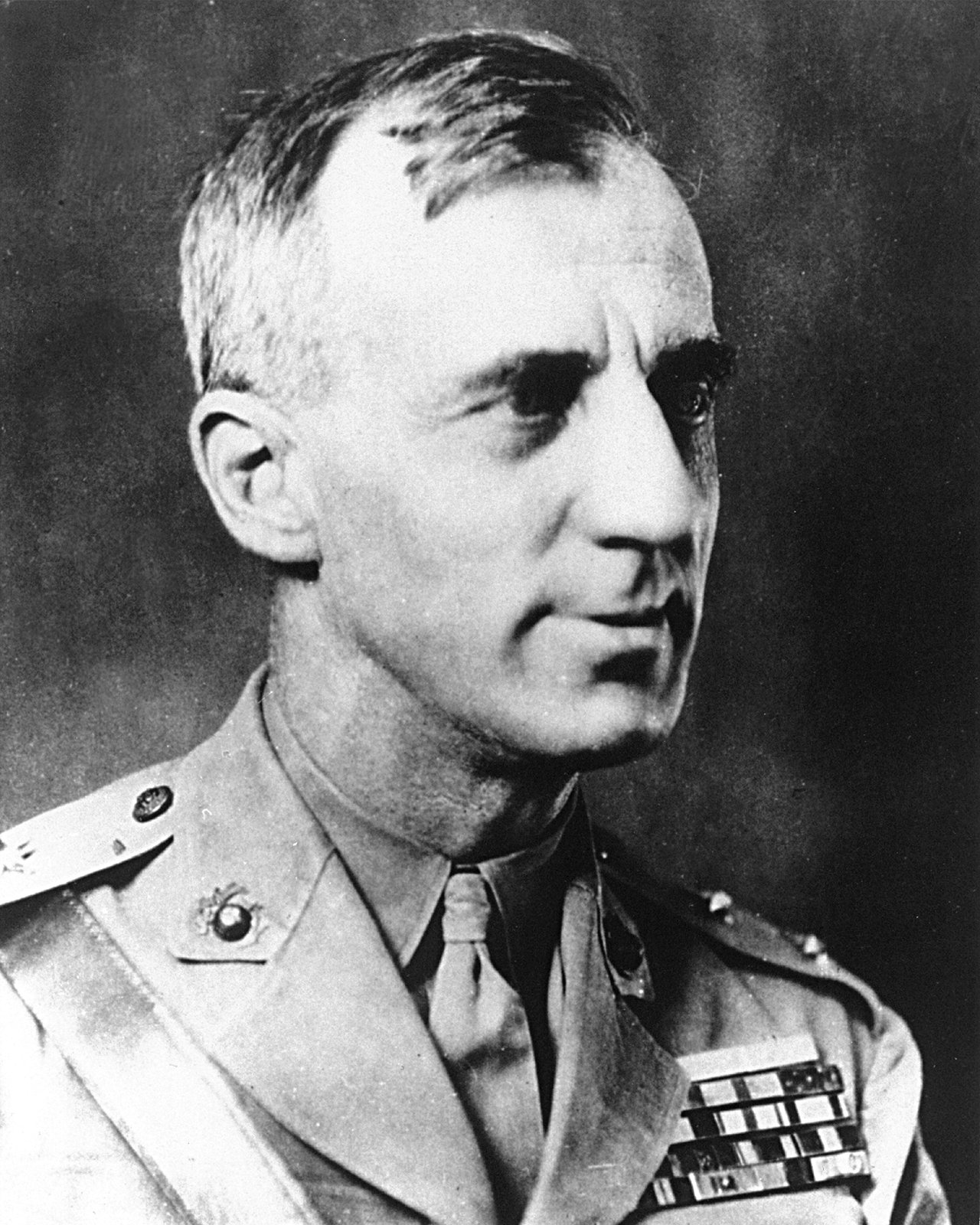

On November 20, 1934, retired Marine Corps Major General Smedley Butler sat before the House Special Committee on Un-American Activities and testified that a bond salesman named Gerald C. MacGuire had approached him with a plan to organize 500,000 veterans into an armed force and use them to pressure or replace President Franklin Roosevelt [2]. Butler was not a marginal witness. He had commanded U.S. Marines in Haiti, Nicaragua, and Mexico and held two Medals of Honor, which made him the natural figurehead for anyone trying to raise a veterans' army.
The approach built over more than a year. MacGuire first contacted Butler in 1933 about a resolution at the American Legion convention opposing Roosevelt's departure from the gold standard. He returned in 1934 with a larger proposal: Butler would lead the veteran force, Roosevelt would be sidelined into a ceremonial role similar to a European head of state under a fascist government, and a new "Secretary of General Affairs" would run the country. MacGuire told Butler he had traveled to France and Italy to study veteran leagues there, including the Croix-de-Feu, as a model [1][2].
The committee's final report, issued February 15, 1935, stated that it had received evidence that "certain persons had made an attempt to establish a fascist organization in this country" and that the attempt "was discussed, was planned, and might have been placed in execution when and if the financial backers deemed it expedient" [1]. MacGuire, called before the committee himself, admitted to the meetings with Butler and to significant unexplained transfers of bond-market funds used for his European travel, while denying that any coup was intended.
What the record establishes without dispute: a sworn general officer reported the approach in detail, a congressional committee corroborated the contacts and the money on MacGuire's own admissions, and no prosecution followed. Contemporary press was openly skeptical. Time's December 1934 piece, headlined "Plot Without Plotters," noted that no signed plan or named financier had been produced in open testimony [3]. MacGuire died two months after testifying, of causes recorded at the time as kidney and heart disease. The plot, real or not, never had an army, a date, or a shot fired.
- [01] U.S. House of Representatives, Special Committee on Un-American Activities (McCormack-Dickstein Committee). Final Report, February 15, 1935.
- [02] Testimony of Maj. Gen. Smedley D. Butler (Ret.), November 20, 1934, before the Special Committee on Un-American Activities.
- [03] "Plot Without Plotters." Time, December 3, 1934.
Because the committee itself found the approach credible, the argument is not over whether something happened but over how far it went and why it stopped where it did. Each reading below has a documented basis and a documented limit.
Wall Street financiers directed a coup that was buried
Archer's reconstruction names men beyond MacGuire in the funding chain: Wall Street broker Grayson M.P. Murphy, an organizer of the American Legion and a director at Guaranty Trust, and Robert Sterling Clark, an heir who MacGuire told Butler had committed as much as $30 million to the effort [1]. Denton's later research ties the same circle to the anti-New Deal financiers behind the American Liberty League [2]. Set against this: the committee's public report never called Murphy, Clark, or any Liberty League figure to testify under oath, and every dollar figure in the record traces back to what MacGuire told Butler rather than to a financier's own bank ledger.
Butler and MacGuire exaggerated ordinary political talk
Time's contemporaries were not alone in doubting the scale of it. No memorandum, membership roll, or signed agreement ever surfaced, and MacGuire's own testimony walked back the coup framing while confirming only that money and travel had occurred. Schmidt's biography takes the opposite position, arguing that Butler was a literal-minded, detail-oriented witness who gave the committee names, dollar amounts, and a European itinerary that MacGuire then independently corroborated on the facts that were checkable [3]. Braggadocio explains a boast. It explains less well why the boast matched a bond salesman's real travel records.
The case was investigated loosely and never pushed
A narrower claim sets aside intent altogether and focuses on the committee's own follow-through: names cited in closed session were left out of the published report, MacGuire was the only figure examined at length, and no one was subpoenaed to explain the source of the money he moved. This gap is real and sits in the committee's own procedural record, not in a rumor about it. Whether it reflects a limited 1935 mandate and a Congress with no appetite for a fight against Wall Street, or something closer to protection, is a question the record leaves open rather than one it answers either way.
- [01] Archer, J. (1973). The Plot to Seize the White House. Hawthorn Books.
- [02] Denton, S. (2012). The Plots Against the President. Bloomsbury.
- [03] Schmidt, H. (1987). Maverick Marine. University Press of Kentucky.