THE BLOOP
In 1997 an underwater microphone array picked up a sound loud enough to be heard across 3,000 miles of ocean. For fifteen years it was the internet's favorite sea monster. It was an iceberg breaking.
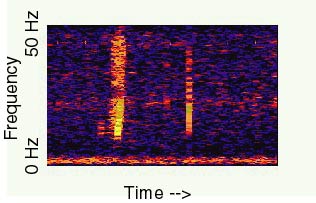

In the summer of 1997, hydrophones operated by the National Oceanic and Atmospheric Administration picked up an ultra-low-frequency sound in the South Pacific. The array was a scientific descendant of the Cold War SOSUS network the Navy had used to listen for Soviet submarines, and NOAA was using it to track undersea earthquakes and volcanic activity [2]. The sound was detected on sensors more than 5,000 kilometers apart, which made it one of the loudest things the array had ever heard. It rose in frequency over about a minute. Sped up sixteen times so a human ear could catch it, it made a sound the analysts wrote down as a bloop, and the name stuck.
Two features drove everything that followed. The first was that the sound had, in NOAA's own early description, a profile broadly consistent with something living: it swept upward in frequency, which is a thing animals do and rock generally does not. The second was the volume. If a creature had made it, that creature would have to be considerably larger than a blue whale, which is the largest animal known to have existed. The internet did the arithmetic and reached for a monster. The rough source location, in the far South Pacific, was noted as being not enormously distant from the coordinates H.P. Lovecraft gave for the sunken city of R'lyeh, and the Bloop entered popular culture as the sound of something that should not exist.
NOAA kept listening. Over the following years the same array and later deployments in the Southern Ocean recorded a large family of related sounds from ice: the grinding of icebergs against the seafloor, the shearing of ice shelves, and the sharp fracture events researchers call icequakes. Recordings made near Antarctica and the Bransfield Strait produced signatures matching the Bloop's shape closely, and the frequency sweep turned out to be a normal feature of a large mass of ice cracking apart [3].
By 2012 NOAA stated the conclusion plainly. The Bloop was an icequake, the sound of a large iceberg fracturing, most likely near Antarctica, with the energy carried thousands of kilometers by the ocean's sound channel [1][4]. The other named sounds from the same era have gone the same way. Julia, Slow Down, and Train are attributed to ice, and Upsweep to a submarine volcano.
The identification is settled. The Bloop was an animal-shaped signal produced by geology, and the reason it sounded biological is that nobody had yet built a catalog of what a continent's worth of breaking ice sounds like from three thousand miles away.
- [01] NOAA Pacific Marine Environmental Laboratory. Acoustics Program, Sounds in the Sea, including the Bloop spectrogram and audio.
- [02] Fox, C.G., Matsumoto, H. & Lau, T.-K. (2001). Monitoring Pacific Ocean seismicity from an autonomous hydrophone array. Journal of Geophysical Research 106.
- [03] Dziak, R.P. et al. (2013). Cryoseismic sources and their acoustic signatures in the Southern Ocean. NOAA PMEL work on iceberg-generated sound.
- [04] NOAA statements (2012) identifying the Bloop as consistent with an icequake, the fracturing of a large iceberg.
The case is closed, and the claims that outlived it are worth reading because of what they show about how a solved mystery keeps its audience. Each has a traceable origin and a documented response. They are laid out in full so you can weigh them yourself.
An undiscovered animal made it
This reading came with NOAA's own early language, which described the sound's profile as consistent with a biological source, and it was amplified by the deep sea's real record of surprises: the colossal squid was not filmed alive until 2007, and new large marine species are still described [1][2]. The response is quantitative. To radiate that much acoustic energy, an animal would need to be many times the length of a blue whale, and an animal that size has metabolic requirements no ocean ecosystem could meet, would have to surface if it breathed air, and would leave carcasses, prey remains, and repeat detections. In fifteen years of continuous listening, the Bloop was never heard again in a form that behaved like a creature, while the ice sounds were heard constantly.
It was military, and the ice story is cover
The array itself was built from Cold War submarine-listening hardware, which invites the suspicion that a Navy-derived system produced a Navy-shaped answer, and that the sound was a weapon test or a classified vehicle [2]. Against it stands the fact that NOAA published the recording, the spectrogram, and the coordinates, which is a strange way to hide something. A concealed source would also have to explain why the same signature keeps appearing in the Southern Ocean near ice shelves and nowhere else.
The icequake identification was asserted, not demonstrated
The most careful objection is that NOAA never published a single paper titled "the Bloop was an iceberg," and that the identification emerged gradually from a body of work on Antarctic ice sounds rather than from a dedicated study of the 1997 event [3]. That is a fair description of how the answer arrived. It is also how identifications usually arrive. The claim rests on matching signatures from thousands of catalogued cryogenic events recorded since, which is a stronger form of evidence than a single retrospective analysis would have been, and no competing source has produced a signature that matches as well.
- [01] NOAA Pacific Marine Environmental Laboratory (1997-2002). Early descriptions of the Bloop noting that its profile resembled that of a living creature.
- [02] Coleman, L. & Huyghe, P. (2003). The Field Guide to Lake Monsters, Sea Serpents, and Other Mystery Denizens of the Deep. Tarcher.
- [03] Dziak, R.P. et al. (2013). NOAA PMEL work on cryogenic sound sources in the Southern Ocean, the basis for the icequake identification.