SIMULATION THEORY
In 2003, Oxford philosopher Nick Bostrom published a trilemma arguing that at least one of three things must be true, one of which is that we are almost certainly living in a computer simulation. Physicists have proposed real tests for it. None have found anything.
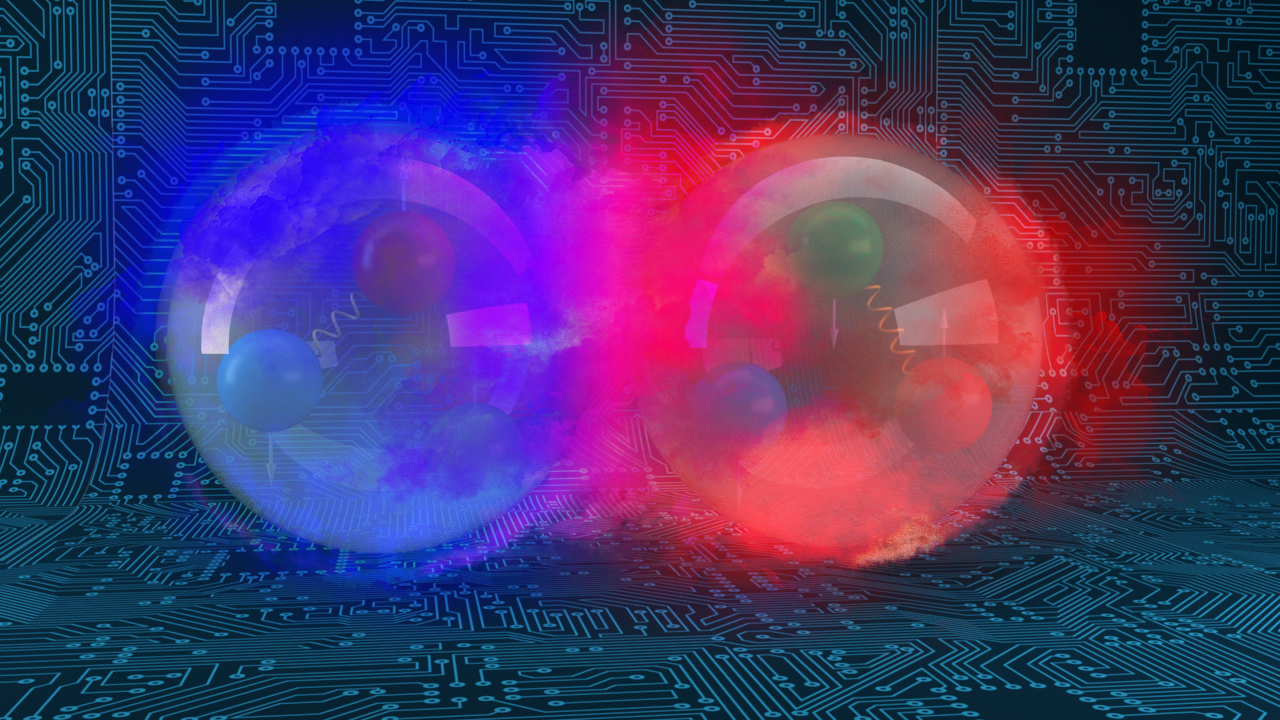

In 2003, Oxford philosopher Nick Bostrom published "Are You Living in a Computer Simulation?" in The Philosophical Quarterly. The paper is a trilemma, not a claim that we are simulated. Bostrom argues that at least one of three propositions must be true: almost every civilization at our level of development goes extinct before it can build the computing power to run detailed ancestor simulations, or every civilization that reaches that point chooses not to run such simulations, or we are almost certainly living inside one [1]. The argument does not pick which branch is true. It only claims the three exhaust the possibilities, and popular retellings routinely drop that structure and report the third branch as Bostrom's conclusion.
The idea reached a wider audience than most philosophy papers because it is, in principle, physical rather than purely metaphysical. If reality runs on an underlying computational lattice the way lattice quantum chromodynamics discretizes spacetime into a grid for numerical calculation, that grid should leave a signature. In 2012, physicists Silas Beane, Zohreh Davoudi, and Martin Savage published a paper working out what that signature would look like, using the historical growth of computing power behind real lattice QCD calculations to estimate how fine a "universe lattice" might be [2]. Their strongest proposed test involves the highest-energy cosmic rays: a discretized universe would break perfect rotational symmetry at extreme energies, producing a measurable directional bias in the cosmic ray spectrum. Their calculated bound on the lattice spacing sits far beyond anything current instruments can probe, and no cosmic ray survey has reported the directional bias their model predicts.
Physicists who have engaged with the argument publicly treat it as a serious thought experiment about computation and cosmology rather than a live challenge to physical theory. The proposed test is real physics, built on real lattice-gauge-theory methods, but it tests one specific and highly restrictive version of the simulation hypothesis, a universe built the way current supercomputers build one. Bostrom's original trilemma makes no claim about what kind of computation an advanced civilization would use, and nothing in the 2003 paper or the 2012 follow-up work has moved the argument from philosophy into confirmed physics.
- [01] Bostrom, N. (2003). Are You Living in a Computer Simulation? The Philosophical Quarterly, 53(211), 243-255.
- [02] Beane, S.R., Davoudi, Z., Savage, M.J. (2014). Constraints on the Universe as a Numerical Simulation. The European Physical Journal A, 50, 148.
Bostrom's trilemma stays philosophy because it makes no testable prediction on its own. The two positions below try to close that gap in different directions, one by treating physical oddities as circumstantial evidence, the other by arguing the question does not need an answer to matter.
Physical anomalies as evidence of an underlying lattice
The Beane, Davoudi, and Savage paper is real physics with a real predicted signature: a discretized spacetime lattice should break perfect rotational symmetry in the highest-energy cosmic rays, at an energy scale set by the lattice spacing [1]. Proponents of the stronger reading treat any reported irregularity in cosmic ray arrival directions, or any unexplained fine-tuning in the physical constants, as a candidate for that signature, since a universe built the way a physics engine renders one would need shortcuts wherever nothing is being directly observed. Against it stands the paper's own numbers: the calculated bound on lattice spacing sits well beyond what any instrument built so far can resolve, and the directional bias it predicts has never been reported in a real cosmic ray survey. An absence of contrary evidence at a precision this coarse is not the same as a confirmed anomaly.
It would not need to be false to matter
A separate line of argument sets aside whether we can prove the hypothesis and asks whether it would change anything if true. At the Code Conference in 2016, Elon Musk told an audience that given how fast video games were approaching photorealism, "the odds that we're in base reality is one in billions" [2]. Philosopher David Chalmers took the opposite emotional stance toward the same premise in his 2022 book Reality+: he argues a simulated world with real causal structure is not a lesser world, just a different substrate, so discovering we live in one would not make anything about our lives less real [3]. Reading these two together undercuts the framing that a simulated universe is automatically a hidden or sinister truth. One treats the odds as alarming. The other treats the whole question as beside the point.
- [01] Beane, S.R., Davoudi, Z., Savage, M.J. (2014). Constraints on the Universe as a Numerical Simulation. The European Physical Journal A, 50, 148.
- [02] Code Conference 2016, Recode, June 2, 2016. Elon Musk remarks on the simulation argument.
- [03] Chalmers, D.J. (2022). Reality+, Virtual Worlds and the Problems of Philosophy. W.W. Norton.