THE ROSWELL INCIDENT
In July 1947 an Army air field announced it had recovered a flying disc near Roswell, New Mexico, then retracted it within a day. What fell is still argued.
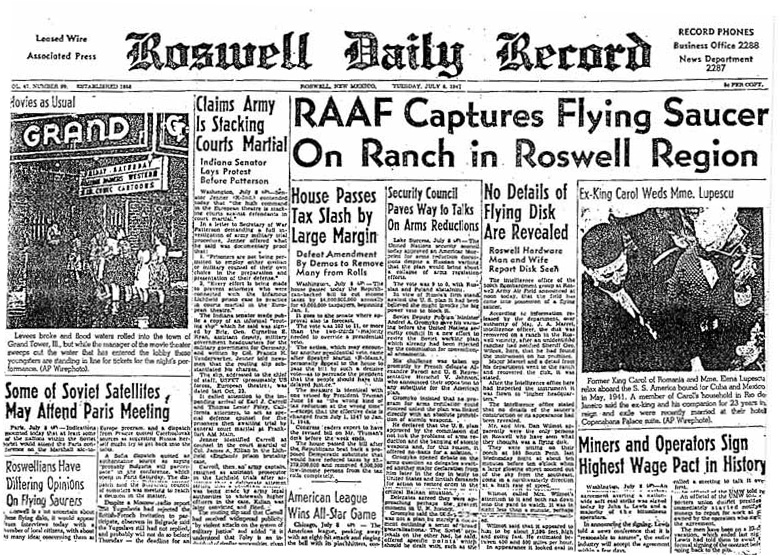

On July 8, 1947, the Roswell Army Air Field issued a press release stating that the 509th Bomb Group had recovered a "flying disc" from a ranch northwest of Roswell, New Mexico. The Roswell Daily Record printed the headline that afternoon [4]. Rancher W.W. "Mac" Brazel had found the material weeks earlier, scattered across his pasture: foil-backed paper, rubber strips, tape, and balsa-like sticks. Within hours, Brigadier General Roger Ramey at Fort Worth Army Air Field identified the wreckage as a weather balloon and its radar reflector, and the Record carried the retraction the next day [5].
For three decades the case drew little attention. The Air Force addressed it directly only in the 1990s. In 1994, prompted by a congressional inquiry, the service concluded the debris came from Project Mogul, a then-secret effort that flew long trains of balloons carrying microphones to high altitude to listen for Soviet nuclear tests [1]. Mogul Flight 4, launched in June 1947 from Alamogordo, used neoprene balloons and radar reflectors built from foil, balsa, and tape, and was never recovered. The reflector tape was reinforced with flower-pattern symbols from a novelty manufacturer, which matches later witness descriptions of "hieroglyphics" along the beams [1][6].
Reports of recovered bodies surfaced much later. The Air Force's 1997 report attributed them to anthropomorphic test dummies dropped in high-altitude parachute experiments across New Mexico between 1953 and 1959, compressed in witnesses' memories alongside a 1956 KC-97 crash and a 1959 manned-balloon accident [2]. The report acknowledged the memory gap of decades but found no record of any other recovery.
A 1995 Government Accountability Office review, requested by Representative Steven Schiff, found that many Roswell base administrative records from 1946 to 1949 had been destroyed years earlier with no documented authorization [3]. It located no records describing the recovery of extraterrestrial material. The two surviving primary documents from July 1947 were the press accounts themselves.
- [01] United States Air Force (1995). The Roswell Report: Fact vs. Fiction in the New Mexico Desert. Washington: GPO. (Project Mogul.)
- [02] United States Air Force (1997). The Roswell Report: Case Closed. Washington: GPO. (Anthropomorphic test dummies.)
- [03] U.S. General Accounting Office (1995). Results of a Search for Records Concerning the 1947 Crash Near Roswell, New Mexico. GAO/NSIAD-95-187.
- [04] Roswell Daily Record, July 8, 1947. 'RAAF Captures Flying Saucer on Ranch in Roswell Region.'
- [05] Roswell Daily Record, July 9, 1947. 'Gen. Ramey Empties Roswell Saucer.' (Retraction.)
- [06] Saler, B., Ziegler, C.A., Moore, C.B. (1997). UFO Crash at Roswell: The Genesis of a Modern Myth. Smithsonian Institution Press.
The Roswell debris has drawn alternative explanations for over forty years. Each has a traceable origin and a documented response. They are laid out in full so you can weigh them yourself.
A crashed extraterrestrial craft (1980)
The modern claim began with The Roswell Incident, a 1980 book by Charles Berlitz and William Moore built on Stanton Friedman's interviews with Major Jesse Marcel, the 509th's intelligence officer in 1947 [1]. Marcel recalled debris unlike any balloon: foil that unfolded with no crease, light beams that would not burn or break, and symbols along them. Later books by Friedman, Randle, and Schmitt added witnesses describing a craft and bodies at a second site [2][3]. The response: the 1995 Air Force report matched the recovered materials, foil-backed paper, balsa, and symbol-printed tape, to Mogul's reflectors, Marcel's accounts shifted over the decades and were first recorded more than thirty years after the event, and no physical fragment has been produced for testing.
The Majestic 12 documents (1984)
In 1984 a roll of undeveloped film reached researcher Jaime Shandera showing papers that described "Majestic 12," a committee President Truman supposedly formed in 1947 to manage a recovered craft and its crew [4]. The response: the FBI reviewed copies and stamped them "BOGUS," analysts found a date format and a Truman signature that appear copied from an unrelated 1947 memo, and the typography did not match documented 1947 government practice.
A disguised Soviet aircraft (2011)
In Area 51, journalist Annie Jacobsen reported an unnamed source's claim that the crash involved a Soviet aircraft based on a Horten flying-wing design, carrying surgically altered teenagers, sent by Stalin to spread panic in the United States [5]. The response: the account rests on a single anonymous source, no corroborating record has surfaced, and aviation historians and UFO researchers alike have rejected it as implausible.
The alien autopsy film (1995)
In 1995 Ray Santilli released footage said to show a 1947 autopsy of a Roswell alien, broadcast in dozens of countries [6]. The response: Santilli later said the footage was a "reconstruction" of film he claimed to have once seen, and special-effects artist John Humphreys described building the body used in it.
- [01] Berlitz, C. & Moore, W. (1980). The Roswell Incident. Grosset & Dunlap. Origin of the crashed-craft claim.
- [02] Friedman, S. & Berliner, D. (1992). Crash at Corona. Paragon House.
- [03] Randle, K. & Schmitt, D. (1991). UFO Crash at Roswell. Avon Books.
- [04] Klass, P.J. (1988). The MJ-12 Crashed-Saucer Documents. Skeptical Inquirer 12(2). On the FBI 'BOGUS' finding and document analysis.
- [05] Jacobsen, A. (2011). Area 51: An Uncensored History of America's Top Secret Military Base. Little, Brown.
- [06] Horne, E. (2006). Eamonn Investigates: Alien Autopsy. Sky/Santilli reconstruction admission; John Humphreys on the prop body.
INFORMAL READER POLL, NOT DATA. WHICH EXPLANATION DO YOU FIND MOST CREDIBLE?