PRISM AND NSA MASS SURVEILLANCE
For years, claiming the NSA collected Americans' communications in bulk marked you as a conspiracy theorist. In June 2013 a contractor handed reporters the documents, and the agency's own slides said it did.
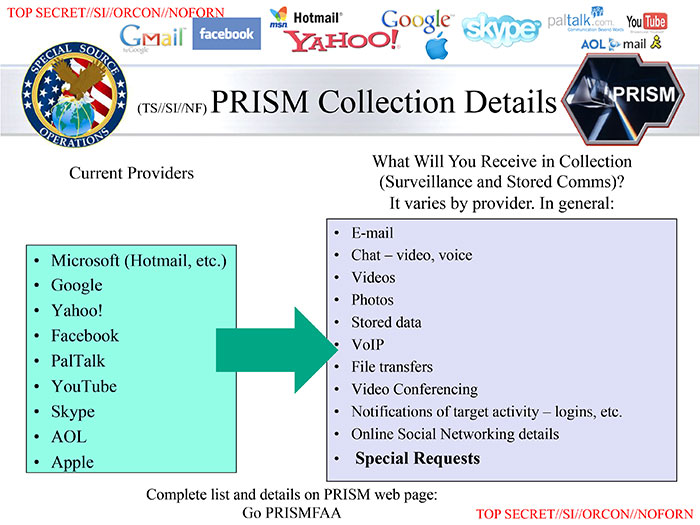

On June 6, 2013, The Guardian and The Washington Post published slides from an internal National Security Agency presentation describing a program called PRISM [1][2]. The slides named the companies whose stored user data the program drew from and the year each was added: Microsoft in 2007, Yahoo in 2008, Google and Facebook in 2009, YouTube in 2010, Skype and AOL in 2011, and Apple in 2012. They listed what could be collected, including email, chat, video, stored files, and voice, and they put the program's cost at roughly twenty million dollars a year. The source was Edward Snowden, a contractor for Booz Allen Hamilton working at an NSA facility in Hawaii, who identified himself publicly three days later.
The same week brought a second document with a shorter path to the point: a secret order from the Foreign Intelligence Surveillance Court, dated April 2013, compelling Verizon to hand the NSA the call records of all its customers, every day, on an ongoing basis. Not the content of the calls, but who called whom, when, and for how long. That program ran under Section 215 of the PATRIOT Act. PRISM ran under Section 702 of the FISA Amendments Act of 2008. Both were legal authorities passed by Congress, interpreted in secret by a court whose opinions were classified.
Officials had denied this in public. In March 2013, three months before the disclosures, Director of National Intelligence James Clapper was asked in a Senate hearing whether the NSA collected any type of data at all on millions of Americans, and answered no. He later described that answer as the least untruthful one he could give, and apologized to the committee in writing.
The government's own review bodies then examined the programs and split on them. The Privacy and Civil Liberties Oversight Board reported in 2014 that the Section 215 bulk telephone records program lacked a viable statutory basis, raised constitutional concerns, and had not identified a single instance in which it made a concrete difference to a terrorism investigation. The same board found the Section 702 program, which includes PRISM, to be lawful and valuable, while warning about the incidental collection of Americans' communications and about searching that data without a warrant [3]. In 2015 the Second Circuit held that Section 215 had never authorized bulk collection at all [4], and Congress ended the program that June with the USA FREEDOM Act. In 2020 the Ninth Circuit held the bulk metadata collection had been unlawful and possibly unconstitutional.
The record is closed on the central question. Mass collection of American communications data happened, under named programs, with corporate participation compelled by court order, and it was concealed and then falsely denied to Congress. The remaining arguments are about scope, legality, and what the programs were worth, not about whether they were real.
- [01] Greenwald, G. & MacAskill, E. (2013). NSA Prism program taps in to user data of Apple, Google and others. The Guardian, June 6, 2013.
- [02] Gellman, B. & Poitras, L. (2013). US, British intelligence mining data from nine US Internet companies in broad secret program. The Washington Post, June 6, 2013.
- [03] Privacy and Civil Liberties Oversight Board (2014). Report on the Telephone Records Program Conducted under Section 215, and Report on the Surveillance Program Operated Pursuant to Section 702.
- [04] American Civil Liberties Union v. Clapper (2015). United States Court of Appeals for the Second Circuit, holding the bulk telephony metadata program was not authorized by Section 215.
The programs are documented, so the claims that remain are the ones that go past the documents. Each has a traceable origin and a response drawn from the same record. They are laid out in full so you can weigh them yourself.
The companies gave the NSA direct access to their servers
The first Guardian and Post stories described PRISM as collection directly from the servers of the named companies, and one slide used that phrasing. Every company named issued a denial within hours, stating that no government agency had direct access and that they turned over data only under specific legal orders [1]. The reporting was later refined: PRISM appears to have worked through compelled, targeted requests delivered to company-run interfaces, not an open pipe into their data centers. The distinction matters, and it is not exculpatory. A separate program, MUSCULAR, did tap the unencrypted links between Google and Yahoo data centers overseas, without those companies' knowledge, which is how the agency got the direct access the companies correctly said they had not granted [2].
Everything is recorded, including the content of every call
A common reading holds that the NSA captures and stores the content of all calls, emails, and messages, everywhere, indefinitely. The Section 215 program collected metadata, not content, and the documents describe content collection under Section 702 as targeted at selectors believed to be foreign, with Americans' communications swept in incidentally rather than universally. Against the reassurance stands the scale of that incidental collection, which the oversight board itself flagged as the program's central privacy problem, and the existence of tools like XKEYSCORE for searching what was gathered. The honest summary is that the surveillance was vast and under-supervised, and also not the total recording that the strongest version claims.
Snowden was working for a foreign intelligence service
A 2016 report by the House intelligence committee questioned his motives and his account, and his subsequent residence in Moscow has kept the suspicion alive [3]. No evidence has been produced that he acted for Russia or China, and the committee's report did not produce any. The journalists who handled the archive have described a source who set conditions to limit harm and who gave them documents rather than selling them [4]. The claim persists because it offers a way to dispose of the disclosures without addressing them, which is the oldest use there is for a question about the messenger.
- [01] Statements by Google, Facebook, Apple, Microsoft and Yahoo (June 2013) denying that any government agency had direct access to their servers.
- [02] Gellman, B. & Soltani, A. (2013). NSA infiltrates links to Yahoo, Google data centers worldwide. The Washington Post, on the MUSCULAR program.
- [03] House Permanent Select Committee on Intelligence (2016). Review of the Unauthorized Disclosures of Former NSA Contractor Edward Snowden.
- [04] Gellman, B. (2020). Dark Mirror. Penguin Press. On what the archive did and did not contain.