PHRENOLOGY
For most of the 19th century, a man could read your character by feeling the bumps on your skull. The method was wrong, the racism it served was real, and the one idea underneath it turned out to be correct.
.jpg)
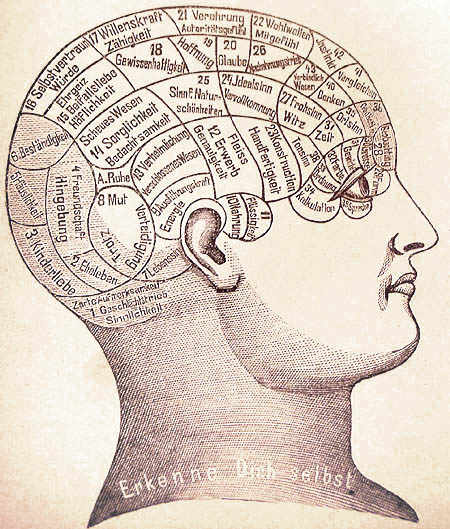
Phrenology began with Franz Joseph Gall, a Viennese physician who argued in the 1790s that the brain is not one organ but many, that each faculty of the mind has its own seat, that a faculty used heavily grows larger, and that the skull swells over the enlarged part. Feel the head, read the person. Gall counted twenty-seven organs. His collaborator Johann Spurzheim raised the number and gave the doctrine its name, and the Edinburgh lawyer George Combe made it a mass movement. His 1828 book The Constitution of Man sold in the hundreds of thousands and was, for a stretch of the century, one of the most widely read books in English [1].
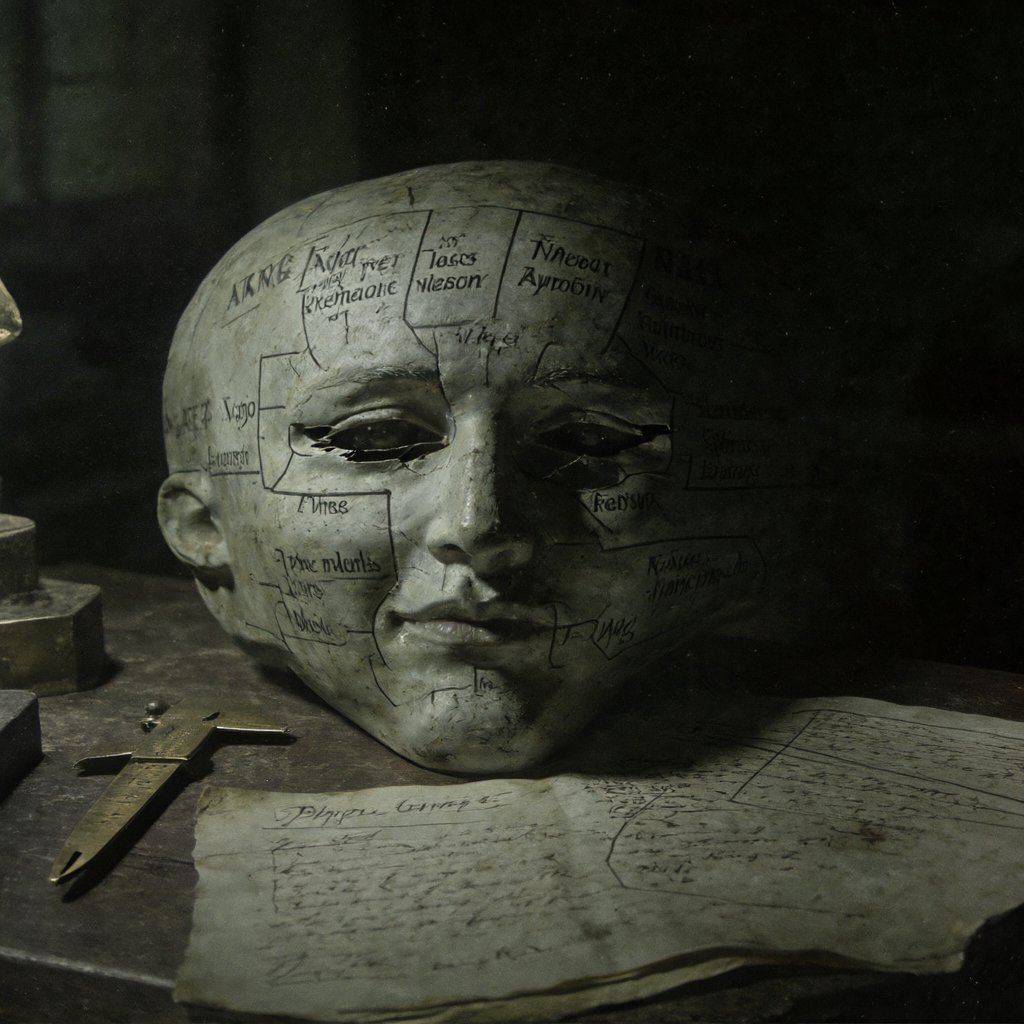
It became an industry. The Fowler brothers in New York gave paid readings, published charts, and sold porcelain heads mapped into regions marked Benevolence, Combativeness, and Amativeness. Employers asked for phrenological certificates. Prison reformers, educators, and insurance men used the readings to sort people.
It was also wrong at every level a claim can be wrong. Pierre Flourens removed specific parts of animal brains in the 1820s and found that the resulting deficits did not match Gall's map at all [2]. The skull does not follow the brain's surface closely enough for the method to work, since bone thickness varies for reasons that have nothing to do with what is under it. And when the individual claims were finally tested against data rather than anecdote, nothing survived. In 2018 an Oxford team used magnetic resonance scans from the UK Biobank to reconstruct scalp curvature for thousands of people and compared local bumps against measured lifestyle and cognitive variables. They found no relationship [3].
The doctrine did real harm on its way out. Skull measurement was carried directly into the racial science of the 19th century, where Samuel Morton's collection of crania was used to rank human groups by supposed capacity, and phrenological reasoning was cited in defense of slavery and of colonial administration. Stephen Jay Gould's The Mismeasure of Man made this the center of its case, and the specifics of his charge against Morton have been disputed since, but the use of skulls to justify hierarchy is not in question.
One part of Gall's thinking outlived him. His core premise, that mental functions are localized in specific regions of the brain rather than distributed through a single undivided organ, was correct. Paul Broca identified a region of the left frontal lobe governing speech production in 1861, working from a patient who could say almost nothing [4], and Carl Wernicke found a comprehension area in 1874. Modern neuroimaging is built on the premise Gall guessed at. He had the right idea and no valid way to test it, and he read it off the outside of the head.
- [01] van Wyhe, J. (2004). Phrenology and the Origins of Victorian Scientific Naturalism. Ashgate.
- [02] Flourens, P. (1842). Examen de la phrénologie. The ablation experiments that contradicted Gall's organ map.
- [03] Parker Jones, O., Alfaro-Almagro, F. & Jbabdi, S. (2018). An empirical, 21st century evaluation of phrenology. Cortex 106, 26-35.
- [04] Broca, P. (1861). Remarques sur le siège de la faculté du langage articulé. Bulletin de la Société Anatomique, on the patient known as Tan.
The method is dead and no one is trying to revive it. What remains contested is what it got right, what it cost, and who has told that story honestly. Each claim has a traceable origin and a documented response. They are laid out in full so you can weigh them yourself.
Gall was right about the brain and punished for it
The claim is that phrenology is dismissed as a joke while its founding insight, that mental functions are localized, is the foundation of every brain scan taken today, and that Gall was driven out of Vienna by a church that objected to a material theory of mind [1]. The first half is accurate and worth saying plainly. The second half does not follow. Being right about a premise does not license the method built on it, and Gall's specific claims about which organ sat where, and about reading them through bone, were tested and failed. A guess that lands is still a guess.
The dismissal was rival science, not evidence
Some historians note that Flourens, phrenology's most effective enemy, held a rigid whole-brain view that was itself wrong, and that the doctrine was attacked as much for its politics as for its errors. Phrenology in Britain was a reformers' science, popular with the self-improving working class and hostile to the idea that character was fixed by birth [3]. This is a fair description of the fight. It is not a defense of the claim, because the empirical case closed regardless of who was arguing. The 2018 Oxford study tested phrenology's central prediction with thousands of subjects and modern imaging, and there was nothing there.
The story of its harm has been overstated
Stephen Jay Gould charged that Samuel Morton unconsciously fudged his skull measurements to rank white Europeans first [2]. In 2011 a team that remeasured Morton's surviving crania reported that Morton's numbers were largely accurate and that Gould's own analysis was the biased one [3]. A later reassessment defended parts of Gould's argument while agreeing he had erred on the data [4]. The dispute is real and unresolved. What it does not touch is the use to which craniometry was put, which is documented independent of Morton's arithmetic, and it is worth noticing that a debate about whether a scientist cheated has absorbed more attention than the century of policy the measurements were used to justify.
- [01] Gall, F.J. (1835). On the Functions of the Brain and of Each of Its Parts. Marsh, Capen & Lyon.
- [02] Gould, S.J. (1981). The Mismeasure of Man. Norton.
- [03] Lewis, J.E. et al. (2011). The mismeasure of science: Stephen Jay Gould versus Samuel George Morton. PLoS Biology 9(6).
- [04] Kaplan, J.M., Pigliucci, M. & Banta, J.A. (2015). Gould on Morton, redux. Studies in History and Philosophy of Biological and Biomedical Sciences 52.