THE PHAISTOS DISC
A clay disc found in a Cretan palace in 1908 carries 241 stamped symbols in a spiral. It is the earliest known example of movable type and nobody can read a word of it.
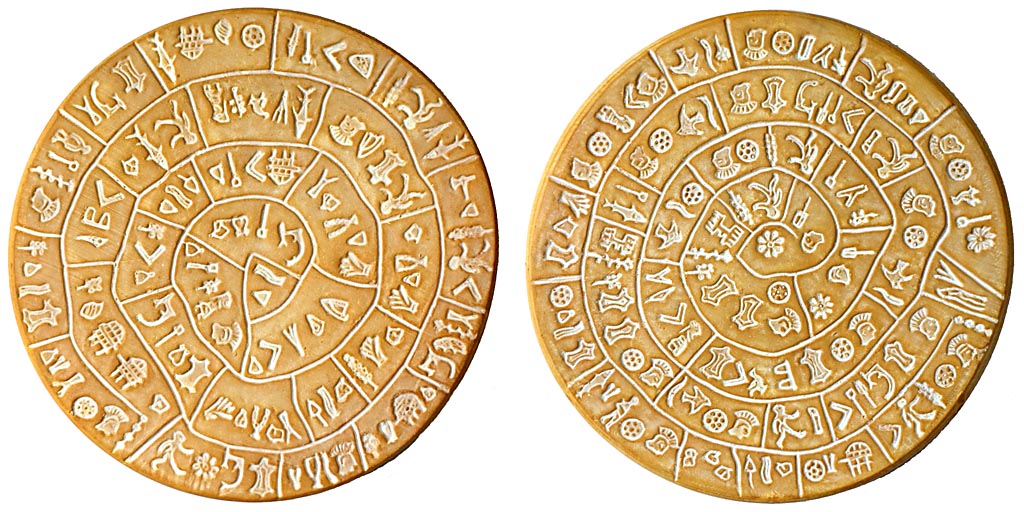

On July 3, 1908, the Italian archaeologist Luigi Pernier was digging in the Minoan palace at Phaistos on Crete and lifted a fired clay disc out of the earth of a basement room. It is about 16 centimeters across and stamped on both sides with 241 signs, arranged in a spiral running from the rim inward, divided by incised lines into 61 groups [1].
The signs were not written. They were stamped, each one pressed into the wet clay with its own individual punch, and there are 45 distinct symbols. That single fact makes the disc extraordinary regardless of what it says. If it is what it appears to be, it is the earliest known example of movable type, produced somewhere around the seventeenth century BC and then apparently never used again by anyone for three thousand years. Making 45 punches is a serious investment for one object, which suggests whoever made them expected to produce more discs. None has ever been found.
Nobody can read it. Over a century of attempts has produced translations claiming it is a prayer to a mother goddess, a call to arms, a legal document, a court list, a musical score, a calendar, and an astronomical almanac. The proposals contradict each other completely, which is the signature of a script that has not been broken rather than one that has [2].
The reason is arithmetic, not lack of effort. Successful decipherments need three things: enough text, a known language behind the script, and ideally a bilingual inscription. Michael Ventris cracked Linear B in 1952 because he had thousands of tablets and, eventually, a language underneath it that turned out to be an early form of Greek. The Phaistos Disc offers 241 signs. That is a single short paragraph, in an unknown script, almost certainly recording an unknown language, with no bilingual anywhere. Yves Duhoux, reviewing the field, argued that the disc simply does not contain enough information to be solved by any method, and that every claimed decipherment has been an exercise in fitting a preferred answer to too few constraints [3].
The one live question about the object itself is authenticity. In 2008 the collector and publisher Jerome Eisenberg argued the disc was a forgery, made to secure Pernier a discovery to rival those of his more celebrated colleagues [4]. Greek authorities have declined to permit the thermoluminescence testing that would settle the date. The mainstream position is that the disc is genuine, undeciphered, and probably undecipherable with the evidence that exists, and that this is an unsatisfying answer which happens to be the correct one.
- [01] Pernier, L. (1908). Il disco di Phaestos con caratteri pittografici. Ausonia 3. The excavation report.
- [02] Robinson, A. (2002). Lost Languages: The Enigma of the World's Undeciphered Scripts. McGraw-Hill.
- [03] Duhoux, Y. (2000). How not to decipher the Phaistos Disc. American Journal of Archaeology 104.
- [04] Eisenberg, J.M. (2008). The Phaistos Disk: One Hundred Year Old Hoax? Minerva 19, and the responses to it.
A single object, forty-five punches, and a century of people certain they have read it. Each claim has a traceable origin and a documented response. They are laid out in full so you can weigh them yourself.
It is a forgery
Jerome Eisenberg's case rests on the disc's isolation: the fired clay is unlike other Minoan tablets, which were baked only by accident in fires; the edges are unusually clean; and nothing remotely similar has been excavated anywhere in a hundred and twenty years of Cretan archaeology. He argued Pernier, working in the shadow of Arthur Evans at Knossos, needed a spectacular find [1]. The response is that the signs show wear consistent with reuse of the punches, that forging a coherent 241-sign inscription in an invented script that has since resisted every statistical attack would be a feat of scholarship in itself, and that a second object bearing similar signs, the Arkalochori Axe, was found later and independently. The dispute could be closed by thermoluminescence dating. Greece has not allowed it, which is the single most frustrating fact in this file and the reason the claim survives.
One of the decipherments is correct
There are dozens, and their proponents are often sincere and sometimes credentialed. Gareth Owens has proposed partial phonetic readings, including a possible word for goddess, working from resemblances to Linear A and B signs [3]. The response is not that any particular reading is absurd, but that the disc cannot discriminate between them. With 241 signs and 45 symbols, most appearing only a handful of times, the statistical constraints are so weak that many mutually contradictory readings can each be made to fit. Duhoux's point stands: when a method produces a different answer in every practitioner's hands, the method is not being tested by the object [2].
It is not writing at all
A quieter proposal holds that the disc is a board game, a calendar, or a ritual object, and that the sign groups are positions rather than words. It explains the spiral, the repetition, and the absence of any other example, since a unique game board needs no sequel. What argues against it is the internal structure. The sign groups show frequency patterns and combinatorial behavior that look like language rather than like a game's spaces, and the deliberate manufacture of 45 individual punches is an enormous effort for one board.
- [01] Eisenberg, J.M. (2008). The Phaistos Disk: One Hundred Year Old Hoax? Minerva 19.
- [02] Duhoux, Y. (2000). How not to decipher the Phaistos Disc. American Journal of Archaeology 104.
- [03] Owens, G. & Coleman, J. (2014). Presentations on a partial phonetic reading of the disc, proposing readings including a word for goddess.
INFORMAL READER POLL, NOT DATA. WHICH EXPLANATION DO YOU FIND MOST CREDIBLE?