OPERATION PAPERCLIP
After World War II the United States brought more than 1,600 German scientists to work on rockets, medicine, and weapons. To get them in, intelligence officers rewrote records that named some as Nazis.
.jpg)
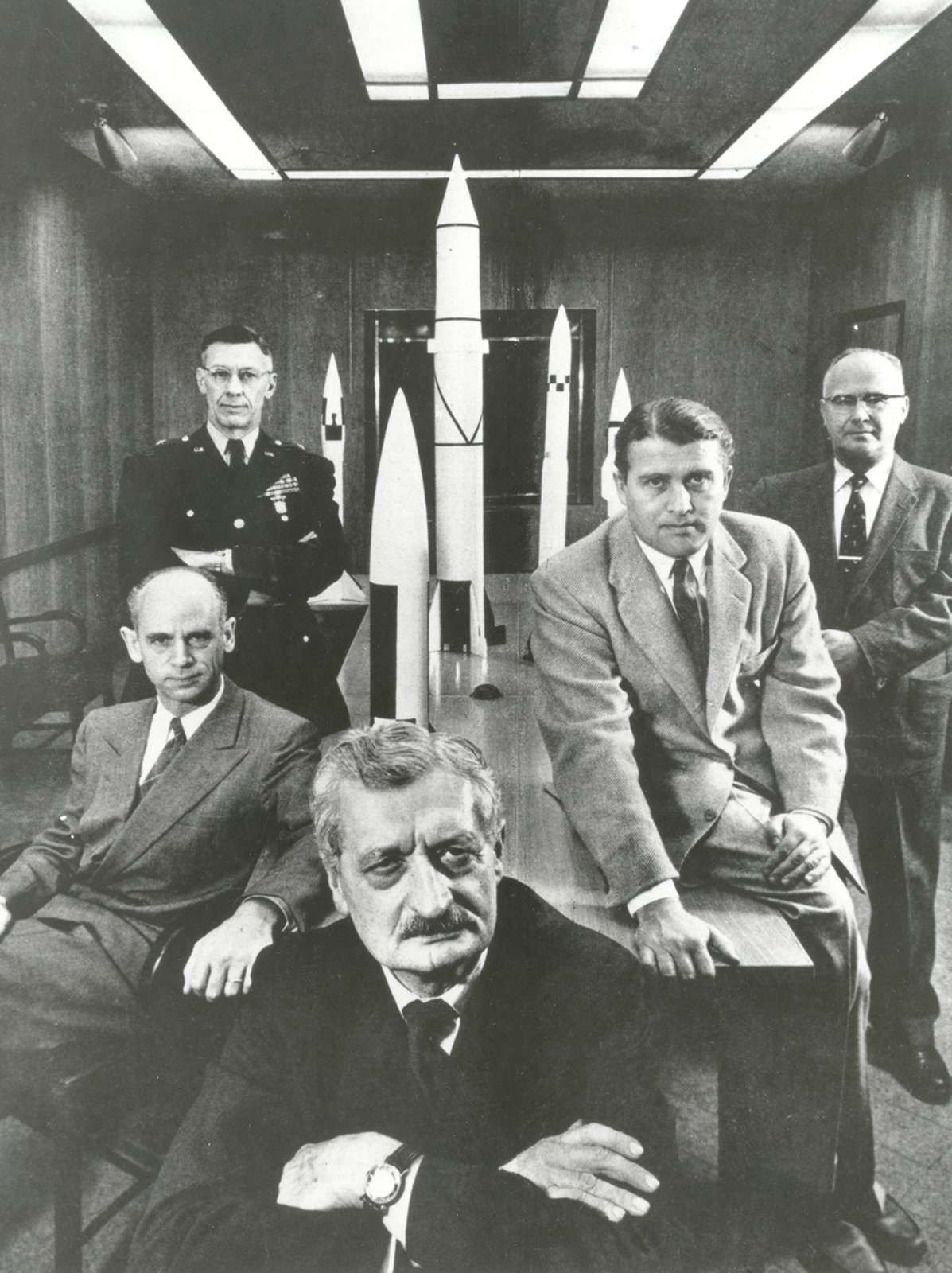
Operation Paperclip was the postwar United States program that recruited German scientists, engineers, and technicians and brought them to work for the American government. From 1945 into the late 1950s it moved more than 1,600 specialists, most famously the rocket engineer Wernher von Braun and his team, who had built the V-2 for Nazi Germany and who went on to develop the rockets that carried American astronauts, including the Saturn V that launched the Apollo missions [1]. The program is not a rumor. It ran under the Joint Intelligence Objectives Agency, and its files sit in the National Archives [4].
The point of controversy is in the record itself. President Truman authorized the recruitment in 1945 but barred anyone who had been an active Nazi or a war supporter. Many of the most valuable recruits could not pass that test, so intelligence officers rewrote their security reports, softening or deleting party membership and wartime conduct to clear them for entry [2]. Historians call these the bleached dossiers.
The human cost behind some of the recruits is documented. The V-2 was assembled at the underground Mittelwerk plant using slave labor from the Dora concentration camp, where thousands of prisoners died. One recruit, Arthur Rudolph, who managed production there and later ran the Saturn V program for NASA, left the United States in 1984 after the Justice Department's Office of Special Investigations moved to strip his citizenship over that record [3]. Others, including the aviation physician Hubertus Strughold, faced lasting questions about wartime experiments.
The mainstream account holds all of this together: a genuine and successful transfer of scientific talent that shaped American rocketry and medicine, obtained by knowingly laundering the wartime histories of some of the people involved. The program is declassified, its benefits are real, and its ethical record is part of the same file.
- [01] Jacobsen, A. (2014). Operation Paperclip. Little, Brown. Built on declassified Joint Intelligence Objectives Agency files.
- [02] Hunt, L. (1991). Secret Agenda. St. Martin's Press. Documents the alteration of recruits' dossiers.
- [03] US Department of Justice, Office of Special Investigations (1984). Denaturalization of Arthur Rudolph over Mittelwerk slave labor.
- [04] US National Archives, records of the Joint Intelligence Objectives Agency (JIOA), Record Group 330.
The declassified program has drawn claims that reach past what the files confirm. Each has a traceable origin and a documented response. They are laid out in full so you can weigh them yourself.
A far larger and darker operation
One claim holds that the released files understate the program, that many more recruits came in, and that worse conduct was buried [1]. The response: the alteration of dossiers is proven, which makes suspicion reasonable, yet the specific larger numbers offered rest on inference rather than on documents, and the archive that exposed the whitewashing is the same archive critics say is incomplete. The proven scandal supports caution, not a settled figure.
A pipeline into mind-control research
A second claim connects Paperclip directly to MK-ULTRA, the CIA program that tested drugs and interrogation on unwitting subjects, casting the German recruits as its scientific core [3]. Against it stands the way the records line up: MK-ULTRA is heavily documented by the Church Committee and grew mainly from domestic and wartime American work, and while a few individuals and research areas touched both worlds, a clean pipeline from one program into the other is asserted more often than it is shown. Overlap is not the same as a chain of command.
A justified and closed trade
A third view treats the whole affair as a defensible Cold War bargain, already settled by the record: the United States took the talent before the Soviet Union could, and the results justified the cost. This reading has the fewest gaps, since the program and its benefits are real. Its limit is moral rather than factual, because accepting it means accepting the bleached dossiers and the Dora deaths as the price, which is exactly what later denaturalization cases such as Arthur Rudolph's reopened.
- [01] Hunt, L. (1991). Secret Agenda. St. Martin's Press. Argues the whitewashing was broader than officially acknowledged.
- [02] Jacobsen, A. (2014). Operation Paperclip and (2011) Area 51. On overlaps with later classified research.
- [03] US Senate, Church Committee (1975-76). Reports on MK-ULTRA and Cold War human experimentation.