OPERATION NORTHWOODS
A 1962 plan, signed by the Joint Chiefs of Staff, proposed staging fake attacks on Americans to justify a war with Cuba. It was rejected. The document is real and declassified.
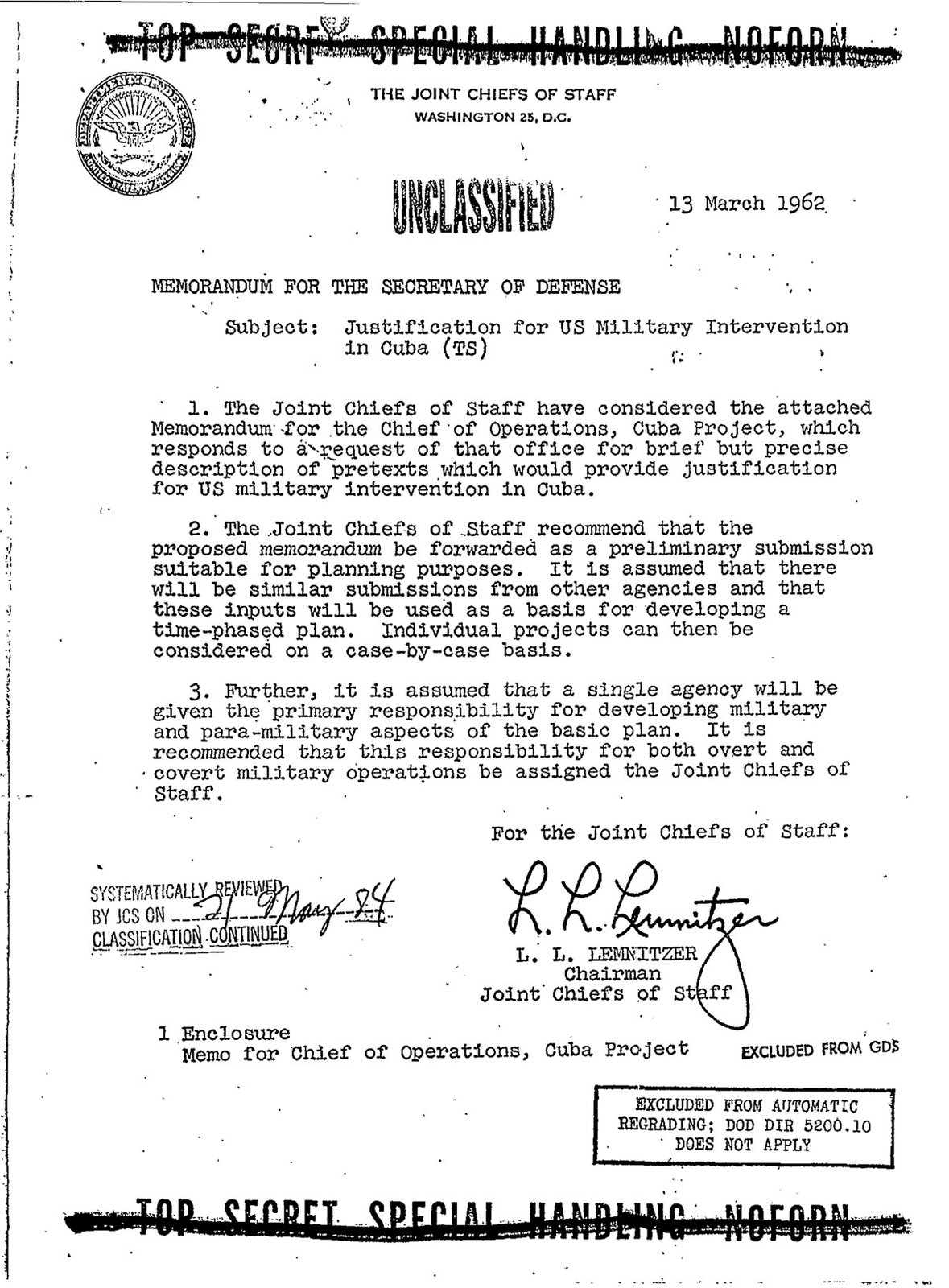

Operation Northwoods was a 1962 proposal from the Joint Chiefs of Staff to manufacture a pretext for war with Cuba. The plan called for staged attacks that would be blamed on the Castro government to build public and international support for a U.S. invasion. The document is real. It was declassified in 1997 by the John F. Kennedy Assassination Records Review Board and is held at the National Security Archive [1].
The proposals were specific. They included faking a Cuban attack on the U.S. base at Guantanamo Bay, blowing up a ship in the harbor and publishing casualty lists in a "Remember the Maine" incident, staging the shootdown of a chartered civilian airliner using a drone substitute, sinking boats of Cuban refugees, and running a fake terror campaign in Miami and Washington [1][2]. The stated aim was to create a "helpful wave of indignation" against Cuba.
Army General Lyman Lemnitzer, chairman of the Joint Chiefs, signed the plan and forwarded it to Secretary of Defense Robert McNamara on March 13, 1962 [3]. The civilian leadership rejected it. McNamara and President Kennedy did not approve any part of the plan, and Lemnitzer was not reappointed as chairman later that year.
What the record establishes is narrow and firm: senior military officers drafted and signed a false-flag proposal, and the elected civilian government refused it. No part of Operation Northwoods was carried out. The memo's importance is that it was written and approved at that level, then stopped.
- [01] Joint Chiefs of Staff (1962). Justification for US Military Intervention in Cuba (Operation Northwoods). Declassified 1997, JFK Assassination Records Review Board. National Security Archive.
- [02] Bamford, J. (2001). Body of Secrets. Doubleday. First wide account of the memo.
- [03] Memorandum, Gen. Lyman Lemnitzer to Secretary of Defense Robert McNamara, March 13, 1962, transmitting the Northwoods plan.
Because the memo is genuine, the dispute is not whether it existed but what it proves. Each reading has a documented response. They are laid out in full so you can weigh them yourself.
Proof the government stages false flags
One reading holds that Northwoods proves the U.S. government will manufacture attacks on its own people, and uses it as a lens for later events such as the Gulf of Tonkin or September 11 [1]. The response: Northwoods shows that such a plan was proposed and rejected at the civilian level, which is itself significant, but applying it to other events is reasoning by analogy. No document ties Northwoods to the execution of any attack, and the plan's own record ends in refusal.
Similar plans were secretly carried out
A stronger version holds that even if Northwoods was rejected on paper, comparable operations went ahead in secret. The response: the United States did run covert action against Cuba in this period, documented as Operation Mongoose, which included sabotage and assassination plots [2]. Those records are real and damning on their own terms, but they are not Northwoods, and no declassified file shows a staged false-flag attack on Americans being executed [3].
A standing template
A related claim treats Northwoods as a reusable blueprint kept on the shelf for future use. The response: the memo was a specific 1962 proposal for one crisis, it was disapproved, and there is no documentary evidence of it being revived or reissued as doctrine.
- [01] Bamford, J. (2001). Body of Secrets. Doubleday. On the rejection of the plan by McNamara and Kennedy.
- [02] U.S. Department of Defense / CIA (1961-1962). Operation Mongoose records on covert action against Cuba, declassified. National Security Archive.
- [03] Church Committee (1975). Findings on covert operations, for the scope of what was and was not carried out against Cuba.