N-RAYS
In 1903 a respected French physicist announced a new kind of radiation. Dozens of scientists confirmed it. Then an American slipped a prism out of the apparatus in the dark and the rays kept appearing.

_titlepage_image.png)
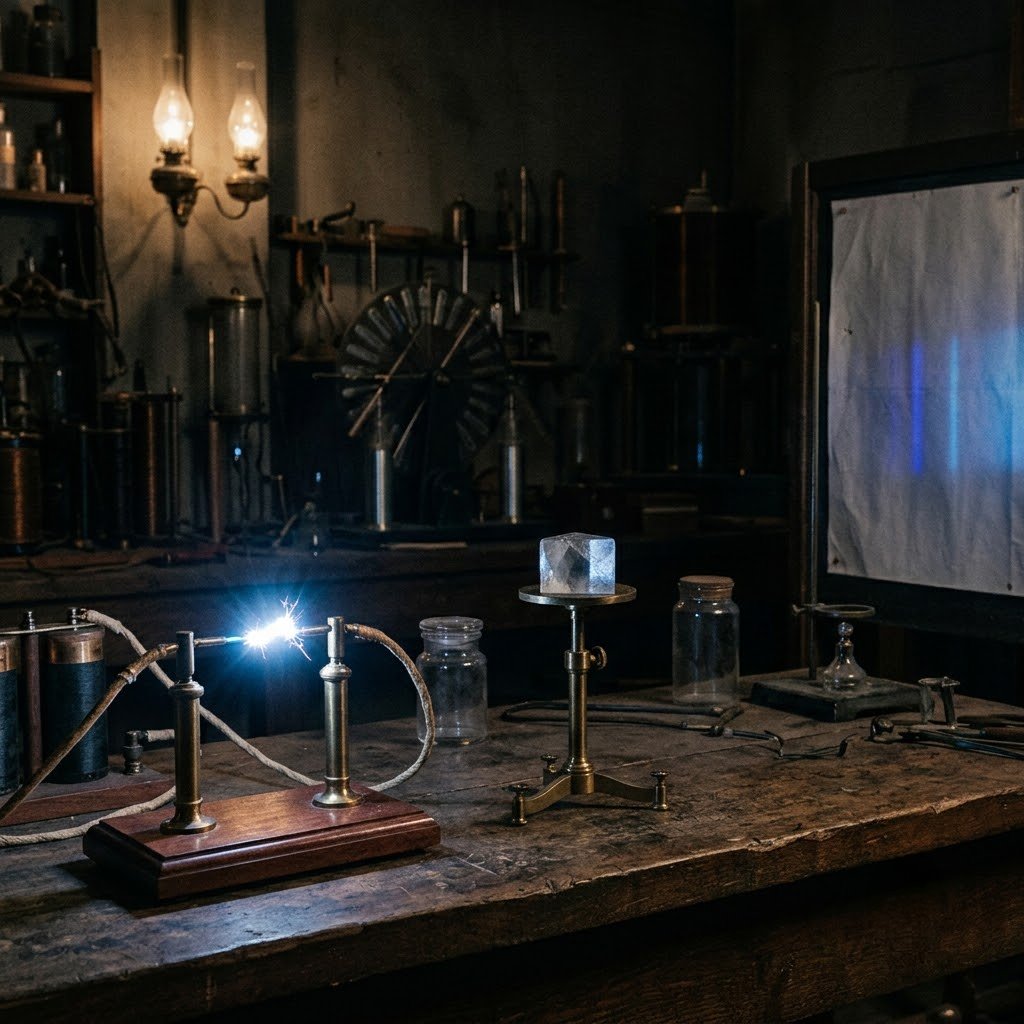
In 1903, not long after the discovery of X-rays, the French physicist René Blondlot at the University of Nancy announced a new form of radiation, which he named N-rays after his city. He reported that many materials emitted them, that they could be bent by an aluminum prism, and that they slightly increased the brightness of a small electric spark or a faintly glowing screen. The detection method was the whole problem in hindsight: an observer judged by eye whether a dim light had grown a little brighter, in a darkened room, knowing what result was expected.
For a time the discovery looked solid. Blondlot was a member of the French Academy of Sciences, other researchers at Nancy and elsewhere confirmed the rays, and within about two years scientists published on the order of 300 papers describing their properties. N-rays seemed to be a genuine French answer to the German X-ray and the newly discovered radioactivity, and national pride ran through the excitement [3].
The turning point came in 1904, when the American physicist Robert W. Wood visited Blondlot's laboratory to see the effect for himself. In the dark, while Blondlot ran a demonstration that depended on an aluminum prism to spread the rays into a spectrum, Wood quietly removed the prism from the apparatus and put it in his pocket. Blondlot, not knowing the key component was gone, continued to report the same spectrum and the same readings [1]. The rays were appearing in an instrument that could no longer produce them, which meant they were coming from the observer's expectation, not from nature.
Wood published his account in Nature, and N-rays collapsed almost at once [1]. Historians and scientists have used the episode ever since as a model case of pathological science, in which sincere researchers, working at the edge of what the eye can judge and wanting a particular answer, confirm an effect that is not there [4]. The mainstream verdict is straightforward: N-rays never existed, and the affair is remembered as a lesson about how easily good scientists can deceive themselves.
- [01] Wood, R.W. (1904). The n-Rays. Nature 70, 530-531. The report that exposed the effect as illusory.
- [02] Klotz, I.M. (1980). The N-ray Affair. Scientific American 242(5), 168-175.
- [03] Nye, M.J. (1980). N-rays: An episode in the history and psychology of science. Historical Studies in the Physical Sciences 11(1).
- [04] Park, R.L. (2000). Voodoo Science. Oxford University Press. On pathological science and self-deception.
The N-ray affair has drawn readings that soften the standard verdict. Each has a traceable origin and a documented response. They are laid out in full so you can weigh them yourself.
A real but delicate effect
One reading suggests Blondlot may have brushed against a faint genuine effect, perhaps a subtle response of the eye or the detector, that he then wrongly built into a whole new radiation [1]. The response: even granting a small perceptual quirk, the claimed physics failed the decisive test, because the readings continued unchanged after Wood removed the prism that was supposed to produce them. Any real signal would have stopped when its source was pulled, and this one did not.
A quarrel driven by national rivalry
A historical reading places the affair inside the rivalry between French science and its German and Anglo-American competitors, arguing that pride made French laboratories confirm the rays and that Wood's very public debunking carried its own nationalism [2]. This context is real and helps explain why the claim spread and why some held on after 1904. It does not rescue the rays themselves, since the reason they fell was an experiment anyone could check, not a verdict handed down by rival nations.
Honest error rather than fraud
The most sympathetic view drops any defense of the rays and insists only that Blondlot was sincere, not a cheat, a careful physicist undone by a detection method that depended on human eyesight [3]. This is widely accepted and is close to the mainstream reading. Its value is in the caution it teaches, since the people fooled were competent and well-meaning, which is precisely why the case is used to warn against trusting an effect that only appears when the observer knows what to look for.
- [01] Blondlot, R. (1905). 'N' Rays: A Collection of Papers. Longmans, Green. Blondlot's own reports of the effect.
- [02] Nye, M.J. (1980). N-rays: An episode in the history and psychology of science. On the French scientific context.
- [03] Klotz, I.M. (1980). The N-ray Affair. On why some French laboratories held to the claim.