THE HOLLOW EARTH
Edmond Halley proposed a hollow Earth to the Royal Society in 1692. In 1818 an Army veteran mailed 500 copies of a circular declaring the planet open at the poles, and in 1897 a Florida religious community ran a 4,000-foot survey on Naples beach to prove we live on the inside of it. Measurement has answered each version, and each one has outlived the answer.
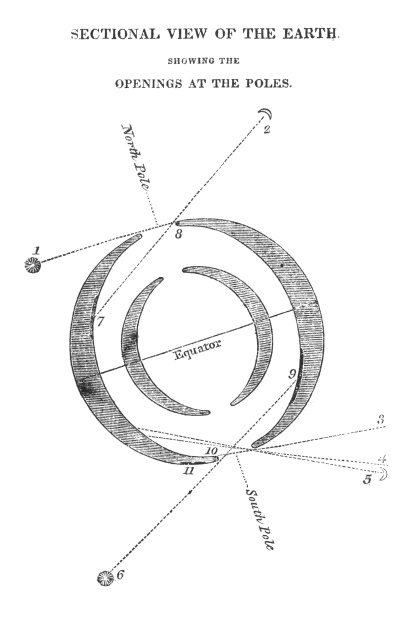

The idea entered science through its front door. In 1692 Edmond Halley, later Astronomer Royal and the man whose name the comet carries, published a paper in the Royal Society's Philosophical Transactions proposing that the Earth was a shell about 500 miles thick, enclosing two smaller concentric shells and an inner core, each separated by an atmosphere [1]. He was trying to explain a real measurement. Compass readings in London had drifted over decades, and Halley reasoned that several magnetic bodies turning at different speeds inside the planet would produce exactly that slow wandering. He also suggested that luminous gas escaping from the interior could cause the aurora.
Symmes and the polar openings
The version most people picture came from John Cleves Symmes Jr., a retired Army officer and veteran of the War of 1812. On April 10, 1818, in St. Louis, he issued his Circular No. 1: "I declare the earth is hollow, and habitable within; containing a number of solid concentrick spheres, one within the other, and that it is open at the poles 12 or 16 degrees" [2]. He mailed about 500 copies at his own expense, to members of Congress, foreign governments, colleges and learned societies, and lectured on it from 1820 with a wooden globe whose polar caps had been cut away. He asked for ships to sail to the northern opening. Congress twice took up petitions to fund him and did not act.
His most capable convert, the newspaper editor Jeremiah N. Reynolds, carried the campaign further than Symmes could. Reynolds made the case for the voyage more and more on scientific and commercial grounds, lobbying for a national expedition to the southern ocean. The House asked President John Quincy Adams to send a ship in 1828, and Reynolds addressed the House on the subject on April 2, 1836 [3]. The United States Exploring Expedition under Charles Wilkes sailed in 1838 and returned in 1842 having charted a long stretch of the Antarctic coast. Reynolds was left off the voyage. It found no opening.
The Koreshans on Naples beach
Florida produced the most literal test. Cyrus Teed, a New York physician who renamed himself Koresh, taught that the Earth is a hollow sphere and that humanity lives on its inside surface, with the sun at the center. His Koreshan Unity moved to Estero, Florida, in 1894. From March into April 1897, its "Geodetic Staff" built a device it called the Rectilineator on the beach at Naples: a frame of wooden sections, squared and leveled, advanced section by section along the shore for more than 4,000 feet as a straight reference line. On a convex Earth the shore should fall away below that line. The staff reported that it curved upward instead, the signature of a concave surface, and published the result in The Cellular Cosmogony in 1898 [4]. Critics pointed to the method: a long frame of wooden sections, leveled by hand and extended one section at a time, accumulates small errors and can sag under its own weight, bending the reference line itself. The Koreshan settlement is now Koreshan State Park.
What measurement found
The physical answer came from weighing the planet. In 1774 Nevil Maskelyne measured how far the mass of Schiehallion, a Scottish mountain, pulled a plumb line off vertical, and Charles Hutton used the result to estimate the Earth's average density at about four and a half times that of water [5]. Henry Cavendish's torsion-balance experiment in 1798 put it near 5.5. Surface rock averages under 3, so the interior has to be far denser than the crust, which a shell hundreds of miles thick around open space cannot be.
Seismology then drew the inside directly. Earthquake waves passing through the planet bend and slow at internal boundaries, and their arrival times at stations around the world map those boundaries. Richard Dixon Oldham identified the core in 1906, and Inge Lehmann showed in 1936 that it has a solid inner part inside a liquid outer one. The waves cross the whole interior. They would not, if it were empty.
- [01] Halley, E. (1692). An Account of the cause of the Change of the Variation of the Magnetical Needle; with an Hypothesis of the Structure of the Internal Parts of the Earth. Philosophical Transactions of the Royal Society, 16(195), 563-578.
- [02] Symmes, J.C. (1818). Circular No. 1, St. Louis, April 10, 1818.
- [03] Reynolds, J.N. (1836). Address, on the Subject of a Surveying and Exploring Expedition to the Pacific Ocean and South Seas. Delivered in the House of Representatives, April 2, 1836.
- [04] Teed, C.R. and Morrow, U.G. (1898). The Cellular Cosmogony. Guiding Star Publishing House. With State Archives of Florida, Florida Memory, photographs of the Koreshan Geodetic Staff at Naples, 1897.
- [05] Hollow Earth, Wikipedia, cross-referenced on the Schiehallion experiment (1774) and Cavendish's density measurement (1798).
The scientific case closed in the 1700s and was sealed by seismology in the twentieth century. The claims below did not need it to stay open. They moved the argument from physics to testimony, books and photographs.
An inhabited inner world: Agartha
The idea that something lives inside came from fiction first and belief second. Edward Bulwer-Lytton's 1871 novel The Coming Race described an advanced civilization underground powered by an energy called Vril [1]. Occult writers in the decades after treated the novel's world as something closer to fact. The Polish explorer Ferdynand Ossendowski reported in Beasts, Men and Gods in 1922 that Mongolian informants had told him of Agharti, a subterranean kingdom ruled by a "King of the World" [2]. Later hollow-earth writers joined the two: a hidden kingdom, an interior sun, and passages to the surface at the poles and under the Himalayas. Ossendowski reported what he said he was told, and offered no location; nobody since has produced one either.
Photographs of the polar holes
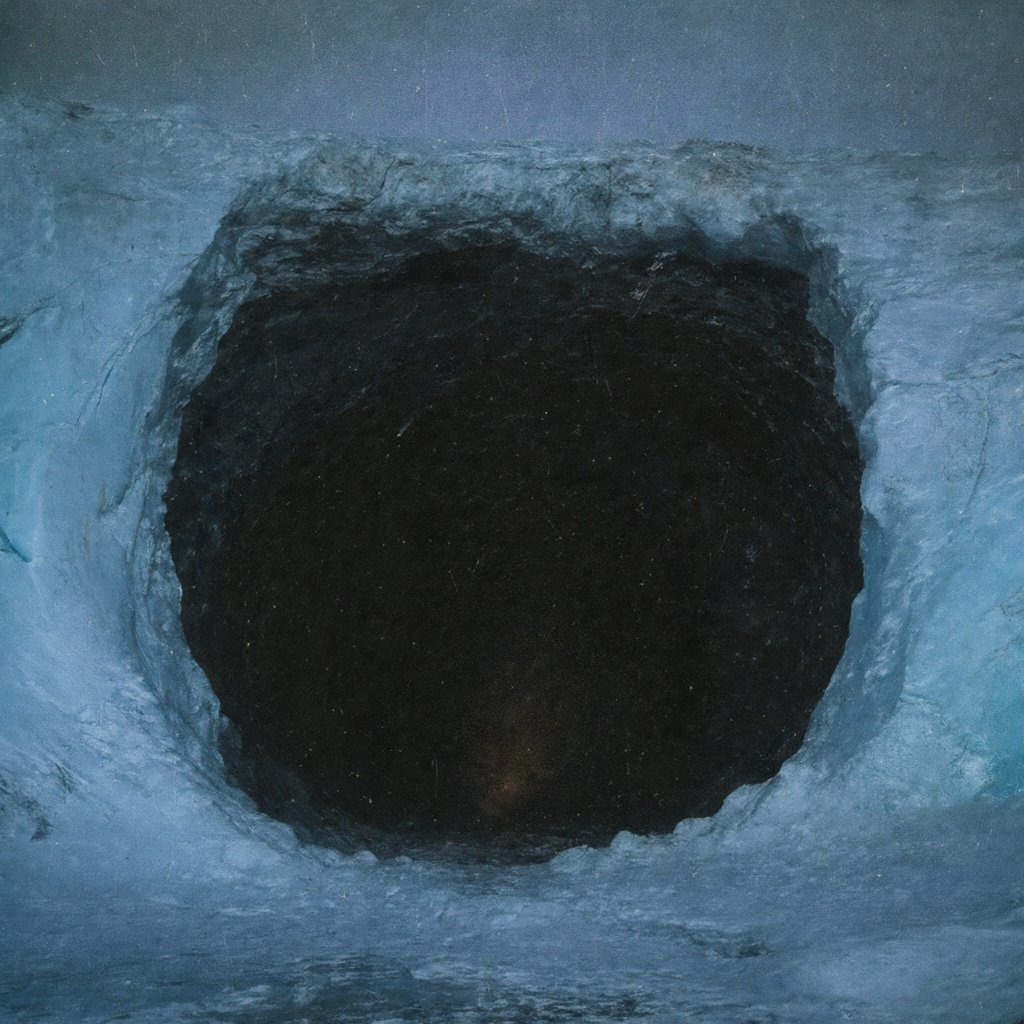
Raymond Bernard's The Hollow Earth, published in 1964, carried the claim into the age of aircraft and satellites. Martin Gardner later identified the author as Walter Siegmeister [3][4]. Bernard argued that polar explorers had flown into the openings without realizing it. A few years later, composite images of the Earth assembled from weather-satellite passes began circulating with a dark disk at the North Pole, and hollow-earth writers presented them as the opening photographed from orbit. The disk is the region that was in polar night when the passes were made, left black in the mosaic because the camera had no sunlit ground to record there. Later imagery of the same region in summer shows ice.
Admiral Byrd's missing diary
The most repeated modern claim attaches itself to Richard E. Byrd, the naval aviator who led expeditions to both polar regions. A text titled as Byrd's missing secret diary began circulating in the late 1970s, through mail-order catalogs and UFO conventions. It describes a flight on February 19, 1947, past the North Pole and into a warm green interior inhabited by an advanced people [4]. Its defenders present it as suppressed testimony from a credible witness. The date is the problem. In February 1947 Byrd was in Antarctica, at the other end of the planet, as officer in charge of Operation Highjump, the Navy's largest Antarctic expedition. The diary surfaced two decades after his death in 1957, and no original in his hand has been produced.
The concave Earth after Teed
The Koreshan version survived its founder. Teed died in 1908, and the community dwindled until its last members deeded the land to Florida in 1961. The concave model reappeared in Germany between the wars as the Hohlweltlehre, the hollow-world doctrine. It has the curious property of being hard to refute by geometry alone, since a suitable mathematical inversion maps every observation on a convex Earth onto a concave one. What it cannot match is the physical record, the same density and seismic measurements that answer the hollow shell, which require the matter of the planet to sit beneath our feet.
- [01] Bulwer-Lytton, E. (1871). The Coming Race. Blackwood.
- [02] Ossendowski, F. (1922). Beasts, Men and Gods. E.P. Dutton.
- [03] Bernard, R. [Walter Siegmeister] (1964). The Hollow Earth. Fieldcrest. Pseudonym identified by Martin Gardner.
- [04] Hollow Earth, Wikipedia, cross-referenced on Ossendowski, Bernard, the polar-opening photograph claims, and the circulation history of the Byrd diary text against the Operation Highjump record.