THE DYATLOV PASS INCIDENT
In February 1959, nine experienced ski hikers cut their way out of their tent and fled into a Ural Mountains night at minus 25 degrees. All nine died. The cause is still argued.
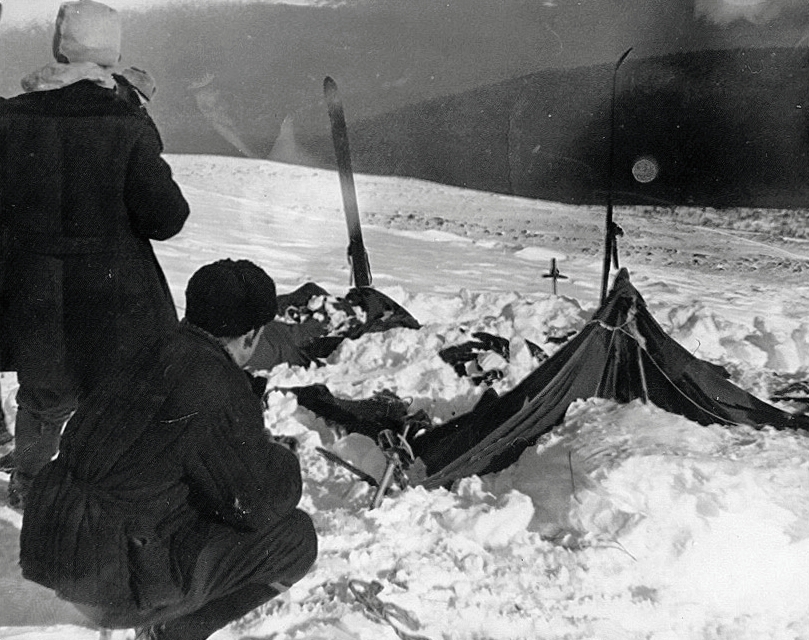

On the night of February 1 to 2, 1959, nine ski hikers led by Igor Dyatlov, most of them students from the Ural Polytechnic Institute, died on the slope of Kholat Syakhl in the northern Urals. They had pitched one tent on an open incline. Searchers found that tent on February 26, partly buried and cut open from the inside. The hikers' bodies lay downslope, some up to about 1,500 meters away, several in only socks or underwear in temperatures near minus 25 degrees Celsius [3].
The injuries drew the most attention. The first bodies showed signs of hypothermia. Others, found later in a ravine, had severe chest and skull fractures, and one was missing her tongue and eyes. The 1959 Soviet inquiry closed the case with the phrase that a "compelling natural force" had caused the deaths, and the file was archived [3].
In 2020 the Russian Prosecutor General's Office concluded a fresh review and named a snow slab avalanche as the cause: a slab released above the tent, the hikers cut their way out and retreated to the treeline, and the cold and the terrain did the rest [2]. In 2021 a study in Communications Earth & Environment by Johan Gaume and Alexander Puzrin modeled how a small delayed slab could release on that shallow slope, cut into the tent, and produce blunt fractures in people lying on a hard surface without burying them [1].
Open questions remain in the literature. Trace radioactivity reported on some clothing, the orange lights other groups in the region described that winter, and the precise sequence of injuries are still debated. The avalanche model accounts for the cut tent, the flight downslope, the fractures, and the cold deaths, while not every detail is settled.
- [01] Gaume, J. & Puzrin, A.M. (2021). Mechanisms of slab avalanche release and impact in the Dyatlov Pass incident in 1959. Communications Earth & Environment 2, 10.
- [02] Russian Prosecutor General's Office (2019-2020). Re-investigation concluding a snow slab avalanche, reported by TASS and Komsomolskaya Pravda.
- [03] Eichar, D. (2013). Dead Mountain. Chronicle Books. Reconstruction of the timeline and the 1959 inquiry's 'compelling natural force' finding.
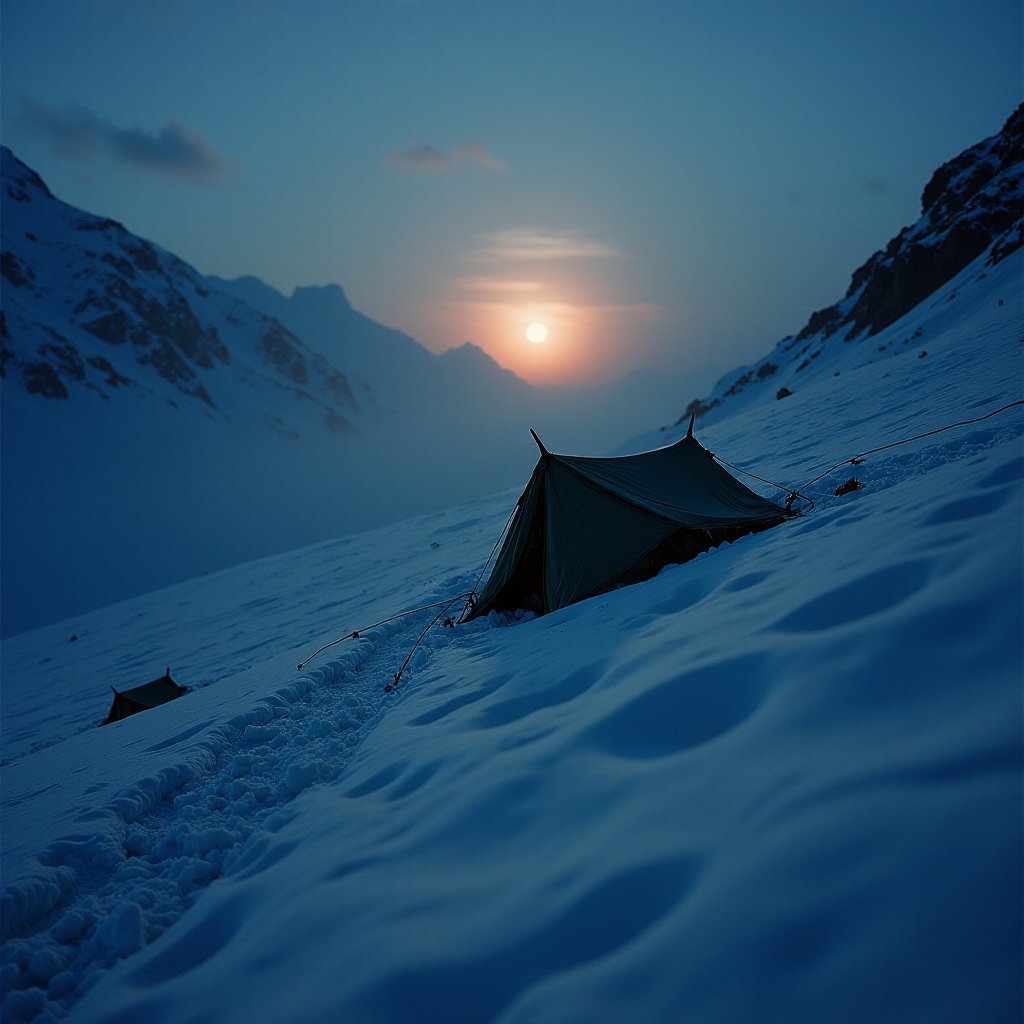
The deaths have drawn explanations beyond the avalanche finding. Each has a traceable origin and a documented response. They are laid out in full so you can weigh them yourself.
A secret military weapons test
This version holds that a weapons test, parachute mines or a missile, killed the group, explaining the blunt internal injuries without external wounds, the orange lights seen that winter, and trace radioactivity reported on two pieces of clothing [2]. The response: the nearest known test ranges were far from the pass, the 2020 review found no record of a test in that area on those dates, the radioactivity has been attributed to thorium in a camping-lantern mantle and to one hiker's prior work with isotopes, and the injuries match a fall onto a hard surface [3].
Infrasound-induced panic
In Dead Mountain, Donnie Eichar proposed that wind passing over the dome of Kholat Syakhl formed a Karman vortex street, generating infrasound that produced dread and nausea strong enough to drive the group out of the tent [1]. The idea fits the panic and the cut tent. It is hard to test, it depends on specific wind and terrain conditions that night, and it does not by itself explain the ravine fractures that the avalanche model accounts for.
An animal or unknown creature
A folklore strand, fed by a blurred frame on the hikers' own camera and by local Mansi stories, attributes the deaths to a bear or an unknown creature. Against it stands the absence of any animal sign: no tracks, no bites or claw wounds, no disturbance of the bodies of the kind a large predator leaves. The Mansi were investigated in 1959 and cleared.
- [01] Eichar, D. (2013). Dead Mountain. Chronicle Books. Source of the Karman-vortex infrasound hypothesis.
- [02] McCloskey, K. (2016). 1079: The Overwhelming Force of Dyatlov Pass. Describes the military-test and radiation claims.
- [03] Russian Prosecutor General's Office (2020). Re-investigation rejecting weapons-test and crime versions in favor of an avalanche.
INFORMAL READER POLL, NOT DATA. WHICH EXPLANATION DO YOU FIND MOST CREDIBLE?