DICYANIN GLASSES
A coal-tar dye said to let the wearer see the human aura. A real 1911 medical experiment, and a claim that the technology was later suppressed.


Dicyanin is a coal-tar-derived photosensitizing dye from the late 19th century, used to extend the color sensitivity of early photographic plates. Its place in fringe history comes from one man.
Walter J. Kilner (1847-1920) was a medical electrician at St. Thomas' Hospital in London. In his 1911 book The Human Atmosphere, he reported that an observer looking through a screen or goggles tinted with dicyanin could perceive a faint envelope around the human body, which he called the aura and treated as a possible diagnostic tool [1]. He described inner and outer bands and changes he linked to illness.
Independent researchers were never able to reproduce his observations. Dicyanin has no property known to physics or chemistry that would reveal a biological field, and its reported effect is consistent with the visual after-effects of staring through a colored filter [2]. The dye itself fell out of use as its photographic role declined. After Kilner's death in 1920 the technique faded from medicine.
- [01] Kilner, W.J. (1911). The Human Atmosphere; or, The Aura Made Visible by the Aid of Chemical Screens. London: Kegan Paul, Trench, Trubner & Co.
- [02] Carroll, R.T. (2003). 'aura.' The Skeptic's Dictionary. John Wiley & Sons.
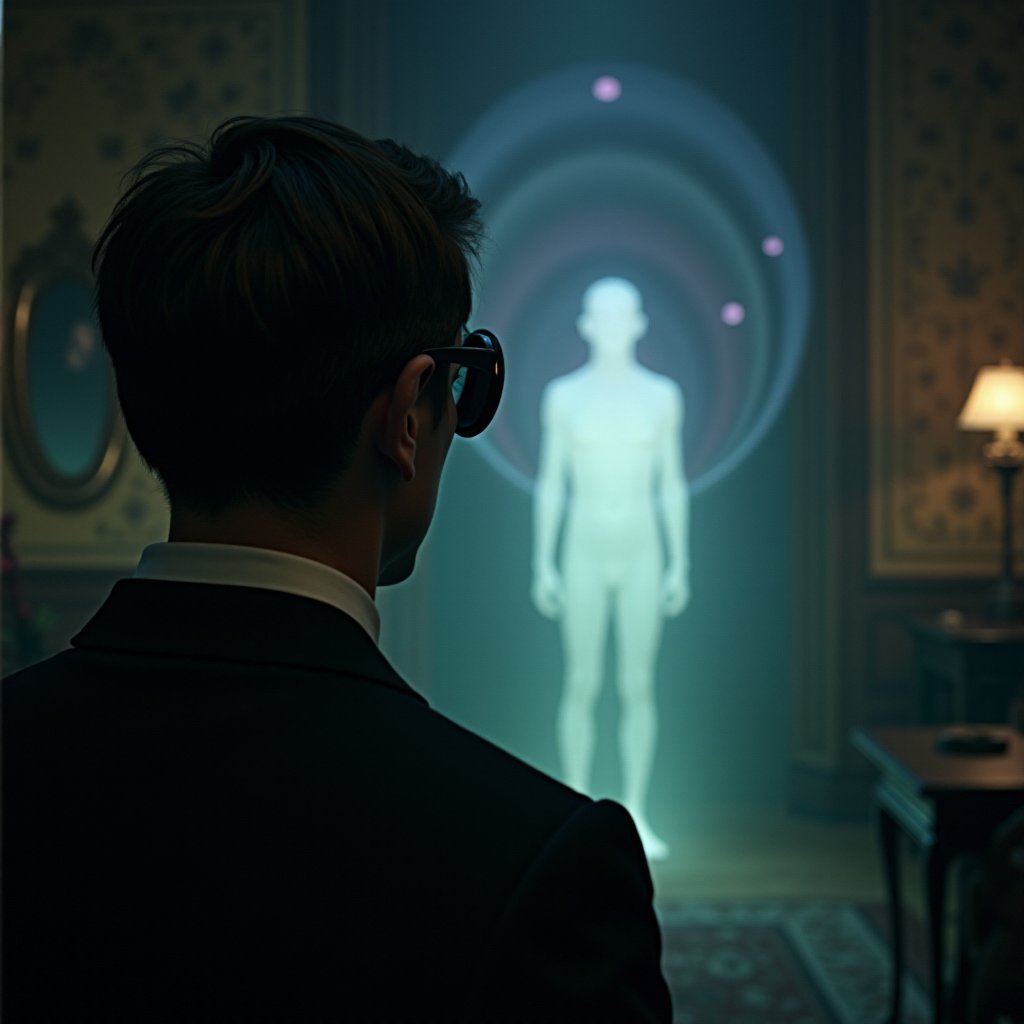
Adherents describe the dicyanin screens as more than a diagnostic curiosity: a pair of glasses that let the wearer see beyond the ordinary range of sight. Through them, the claim goes, a user could perceive auras and etheric bodies, multi-colored emanations around every living being, geometric figures hovering in apparently empty rooms, and shapes that vanished the instant the goggles came off.
The suppression claim follows from there. Some versions hold that the glasses were prohibited in the United States, and that the aim was buried because it handed ordinary people direct proof of an unseen layer of reality. Oscar Bagnall extended Kilner's method in his 1937 book and reported similar sightings, which adherents cite as confirmation that the effect is real and repeatable [1][2].
The documented record runs against the strong version. Kilner's own results were not reproduced by independent observers, dicyanin is a known photographic dye with no measured field-sensing property, and there is no regulatory record of dicyanin glasses being banned in the United States. The dye became hard to obtain mainly because its use in photography ended, not through any prohibition. The full text of Kilner's book remains freely available [3].
- [01] Kilner, W.J. (1911). The Human Atmosphere. The original claim that the screens reveal the aura.
- [02] Bagnall, O. (1937). The Origin and Properties of the Human Aura. London: Kegan Paul. A revival of Kilner's dicyanin-screen method.
- [03] sacred-texts.com, archived full text of Kilner's The Human Atmosphere.
INFORMAL READER POLL, NOT DATA. WHICH EXPLANATION DO YOU FIND MOST CREDIBLE?