THE COTTINGLEY FAIRIES
Two girls in a Yorkshire village photographed fairies in 1917. The man who created Sherlock Holmes believed them. Sixty-six years later, the girls explained how they did it, and one of them kept insisting the last photo was real.

In July 1917, sixteen-year-old Elsie Wright borrowed her father's quarter-plate camera and went down to the beck behind the house in Cottingley, a village near Bradford in West Yorkshire. She came back with a photograph of her nine-year-old cousin Frances Griffiths resting her chin on her hand while four winged fairies danced in front of her. A second plate that September showed Elsie with a gnome. Her father, Arthur Wright, an engineer, thought they were fakes and refused to lend the camera again. Her mother did not.
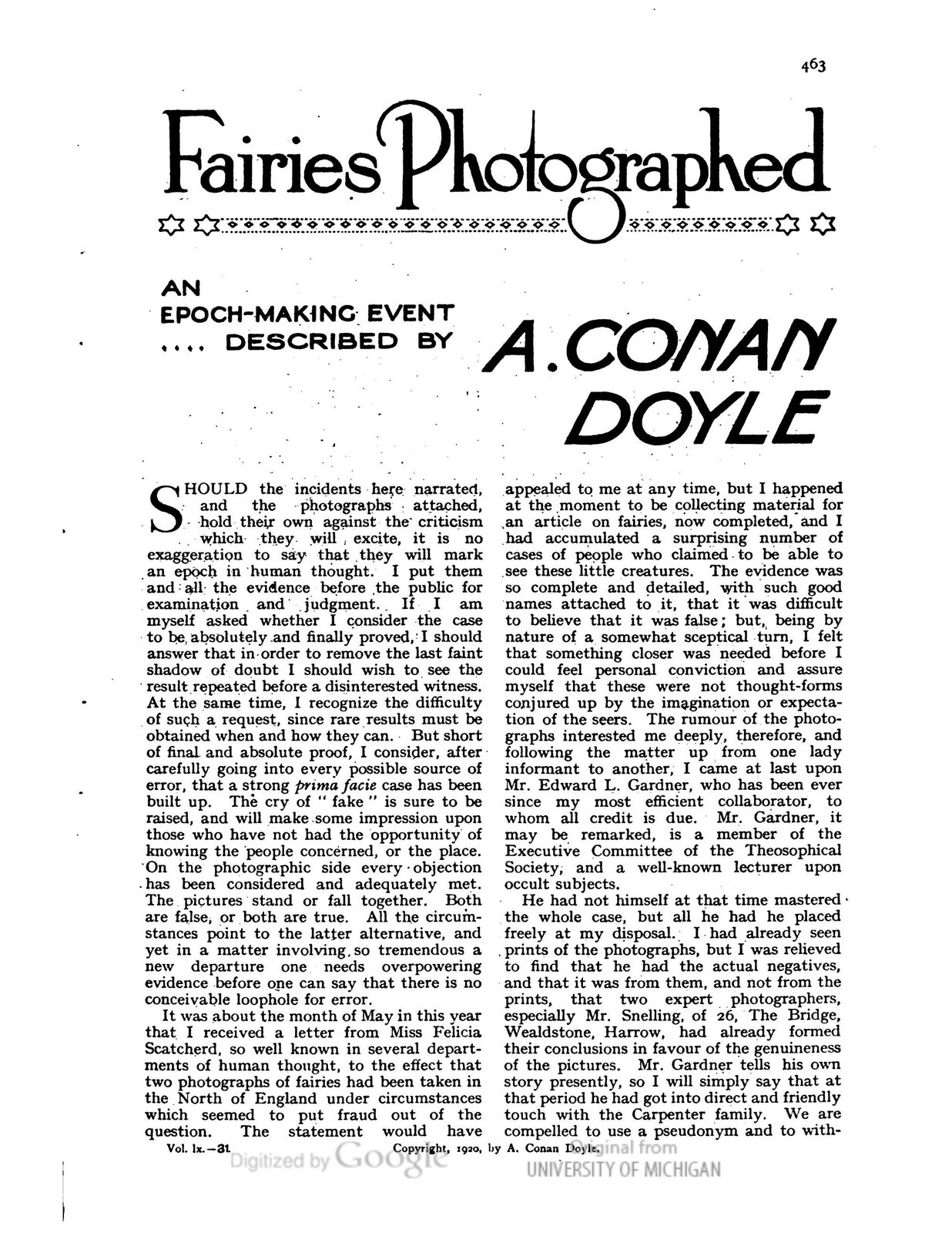
The photographs travelled from a Theosophical Society meeting in Bradford to Edward Gardner, a leading Theosophist, and from Gardner to Arthur Conan Doyle. Doyle, who was writing about fairies for The Strand and had become a committed spiritualist after the war, had the plates examined by Kodak, which declined to certify them as genuine but said it could see no evidence of a fake. He published them in the Christmas 1920 Strand under the headline that fairies had been photographed, calling it an epoch-making event [1]. Three more photographs followed in August 1920, taken after Gardner sent the girls better cameras and asked them for more. Doyle published a full defense in 1922 as The Coming of the Fairies [4].
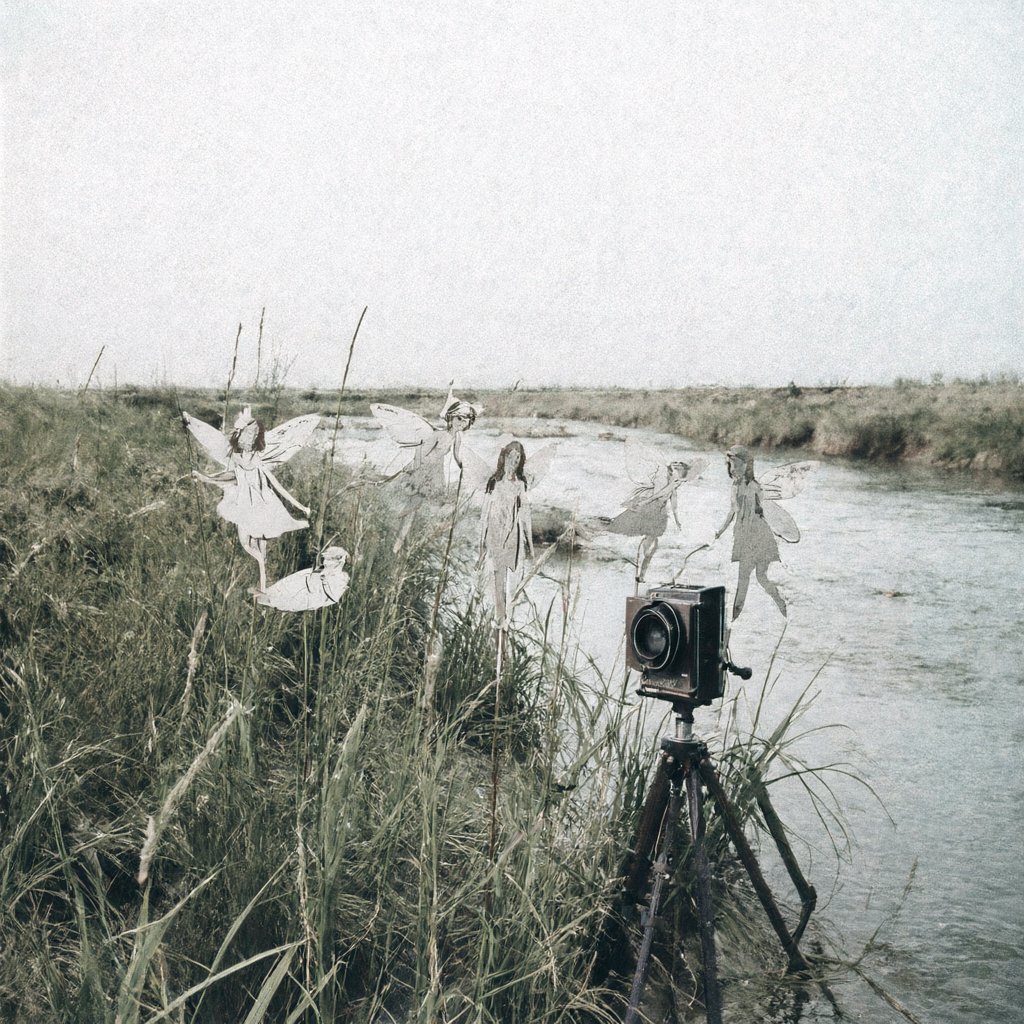
The pictures were cutouts. Elsie, who had trained briefly at an art college and worked for a photographer, drew the figures on stiffened paper, copying the poses from illustrations by Claude Shepperson in a popular 1914 anthology, Princess Mary's Gift Book. The fairies were propped in the grass on hatpins. The hatpin shows in one image as a small point at a fairy's middle, which Doyle interpreted as her navel.
The technical case was assembled by Geoffrey Crawley, editor of the British Journal of Photography, in a ten-part series published across 1982 and 1983 [2]. Then the girls, by now women in their seventies and eighties, admitted it. In interviews with the researcher Joe Cooper, both said the photographs had been faked with paper cutouts, and that they had kept the secret for decades because Conan Doyle had been so publicly certain and they could not bear to embarrass him [3]. Elsie said all five were fakes. Frances said four were.
The account that survives every test is the simple one. Two girls made a joke that no one their age could have stopped once it left the house, a famous man with a stake in the answer authenticated it, and a hoax that took an afternoon to make took sixty-six years to end.
- [01] Doyle, A.C. (1920). Fairies Photographed: An Epoch-Making Event. The Strand Magazine, December 1920.
- [02] Crawley, G. (1982-83). That Astonishing Affair of the Cottingley Fairies. British Journal of Photography, a ten-part technical analysis.
- [03] Cooper, J. (1990). The Case of the Cottingley Fairies. Robert Hale. Includes the 1983 admissions.
- [04] Doyle, A.C. (1922). The Coming of the Fairies. Hodder & Stoughton.
Both women confessed, and the case is closed on the photographs. What people still argue about is what the confession did not cover. Each claim has a traceable origin and a documented response. They are laid out in full so you can weigh them yourself.
The fifth photograph is genuine
This claim comes from inside the hoax. When Frances Griffiths admitted the fakes, she made an exception for the last image, Fairies and Their Sun-Bath, taken in August 1920, and she never withdrew it [1][2]. Elsie said all five were faked. The photograph is different in character from the others, showing an indistinct nest of shapes in the grass rather than the crisp posed figures of the earlier plates, and it is the one image nobody has matched to a source illustration. Against it stands the plainest fact in the file: the two people who made the pictures disagree, one of them says it is a fake, and a photograph that only looks genuine because it is blurry is not evidence of anything.
They faked the pictures but saw the fairies
Frances held this position for the rest of her life. She said she and Elsie had gone down to the beck because they really did see things there, that the adults would not believe them, and that the photographs were made to prove something she believed was true rather than to invent it [1]. It is the version that explains the girls' behavior without requiring the pictures to be real. It is also unfalsifiable, which she seemed to understand, and she offered it as testimony rather than proof.
The confession is unreliable
A few defenders have argued that two elderly women, worn down by sixty years of questions and by a researcher who wanted an answer, said what would make it stop. Doyle's original argument runs underneath this one: he insisted that girls of that age and background could not have produced such convincing images [3]. The record answers him directly. Elsie had art training and had worked in a photographer's studio retouching prints, the source illustrations were traced to a book that was in the house, and Geoffrey Crawley reached the same conclusion from the plates alone before either woman said a word [2]. The confession did not create the case. It caught up with it.
- [01] Griffiths, F. Statements from the 1980s maintaining that the fifth photograph, Fairies and Their Sun-Bath, was genuine and that she had really seen fairies at the beck.
- [02] Cooper, J. (1982). Cottingley: At Last the Truth. The Unexplained, issue 117, in which the admissions first appeared.
- [03] Doyle, A.C. (1922). The Coming of the Fairies. On the argument that two working-class girls could not have produced the images.