THE BEALE CIPHERS
An 1885 pamphlet sold for 50 cents in Lynchburg, Virginia, printed three columns of numbers said to hide the location of a buried treasure. One was solved with the Declaration of Independence as its key. The other two have resisted every attempt for 140 years, and the strongest evidence about them suggests they may not encode anything at all.
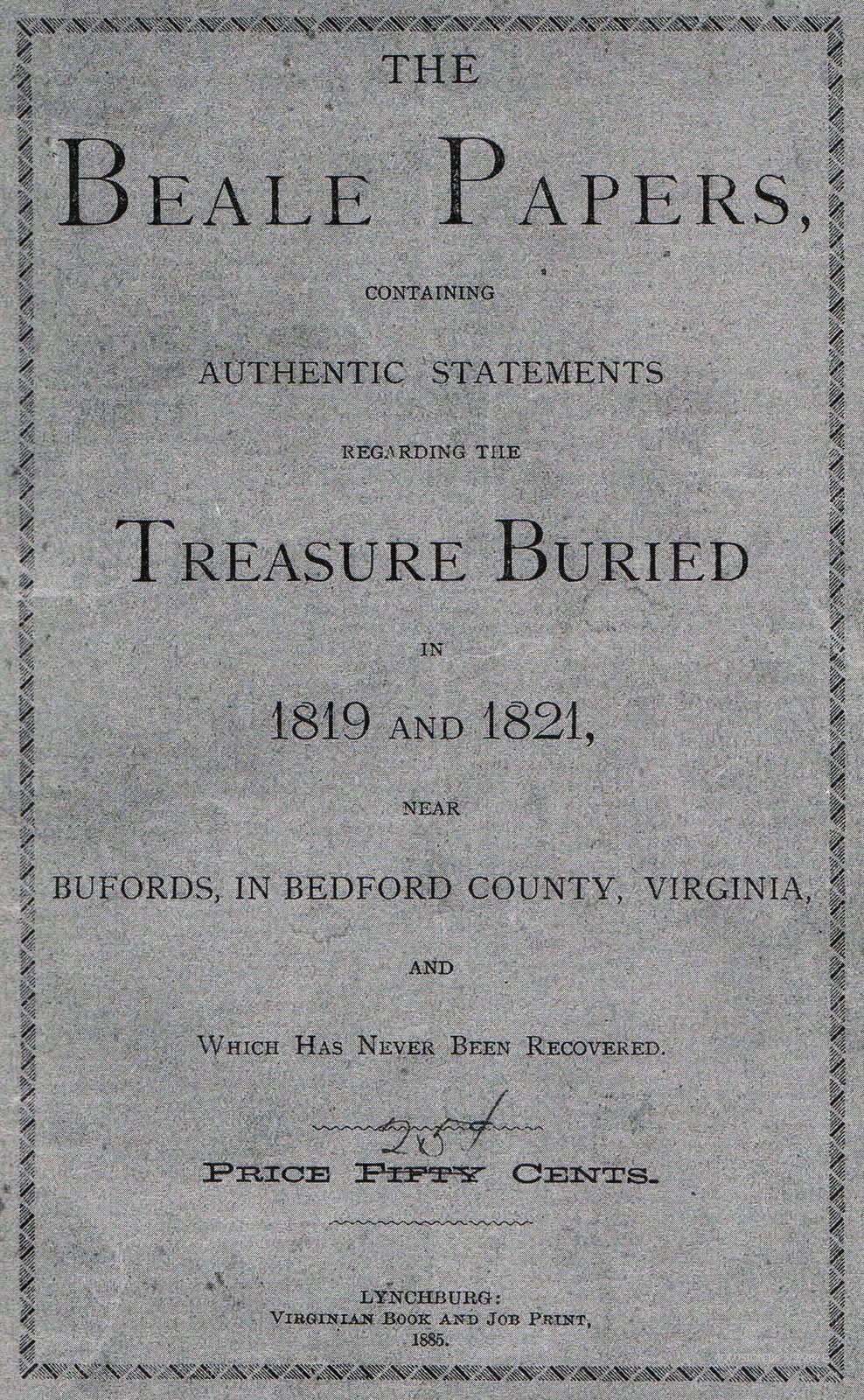
_-_Cover.jpg)
The whole case rests on one document. In 1885 James B. Ward of Lynchburg, Virginia, published a pamphlet called The Beale Papers and sold it for 50 cents, a steep price for a pamphlet at the time [1][4]. Everything known about Thomas J. Beale, his treasure and his ciphers comes from it. Researchers have not found an independent record that confirms the Beale of the pamphlet existed.
The pamphlet's story runs like this. Beale led a party of about thirty men west in 1817, and they found gold and silver in the territory north of Santa Fe. Over the next few years they hauled it back and buried it in Bedford County, Virginia, in a vault lined with stone. In 1822 Beale left a locked box with Robert Morriss, a Lynchburg innkeeper, asking him to keep it safe and open it if no one returned for it. Nobody came. Morriss opened the box in 1845 and found three pages of numbers he could not read, plus letters explaining that a key would be mailed separately. It never arrived. Before he died, Morriss passed the papers to a friend, the pamphlet's unnamed author, who spent years on them [1].
The cipher that was solved
The second of the three ciphers fell to a book cipher. Each number points to a word in the Declaration of Independence, and the first letter of that word gives one letter of the message. Decoded, cipher 2 describes the deposit: 2,921 pounds of gold, 5,100 pounds of silver, and jewels bought in St. Louis to save transport, stored in pots in a vault "about four miles from Buford's." It says cipher 1 gives the exact location and cipher 3 names the party's members and their heirs [1]. The solution can be checked by anyone with a copy of the Declaration, which is why nobody disputes that cipher 2 is real encryption.
What happens when the same key meets cipher 1
In 1980 the cryptographer Jim Gillogly ran cipher 1 through the Declaration of Independence key. It produced no message. In the middle of the output, though, it produced this: ABFDEFGHIIJKLMMNOHPP [2]. A run of letters climbing nearly in alphabetical order does not arise by chance; Gillogly estimated the odds of the core run, DEFGHIIJKLMMNO, appearing randomly at about one in a trillion. His reading was that whoever built cipher 1 picked numbers by working through the Declaration in order and may never have encrypted a message at all, which would make it a hoax [2].
The language of the letters
Two years later the investigator Joe Nickell examined the Beale letters themselves in The Virginia Magazine of History and Biography. He found words that would be early or out of place for a man writing in 1822, including "stampeding" and "improvise," and he argued the letters and the pamphlet's narrative read like the work of one writer [3][4]. No contemporary record of Beale, Morriss's box, or the thirty-man party has been found in the century and more of searching since.
Treasure hunters have dug in Bedford County for well over a hundred years, some with permission and some without. No vault has been found.
- [01] Ward, J.B. (1885). The Beale Papers, Containing Authentic Statements Regarding the Treasure Buried in 1819 and 1821, near Bufords, in Bedford County, Virginia. Lynchburg, Virginia.
- [02] Gillogly, J.J. (1980). The Beale Cipher: A Dissenting Opinion. Cryptologia, 4(2), 116.
- [03] Nickell, J. (1982). Discovered: The Secret of Beale's Treasure. The Virginia Magazine of History and Biography, 90(3).
- [04] Beale ciphers, Wikipedia, cross-referenced against Gillogly (1980) and Nickell (1982).
The hoax reading has the strongest single piece of evidence, the alphabetical run, and the people who still search Bedford County know it. They have answers, some better than others.
A real record whose keys were never found
The case for genuine ciphers starts with cipher 2. Whoever wrote it built a working book cipher on a long public text, and built it well enough that it was broken only because the right document was guessed. If one of the three is real encryption, the argument goes, the other two may simply use different key texts that nobody has tried. Carl Hammer, a computer scientist at Sperry Univac, ran statistical tests on ciphers 1 and 3 and reported that their numbers did not behave like random filler. He read that as a sign they encode intelligible text [1]. Skeptics accept the measurement and dispute the reading. Numbers picked by a forger working through a document in order would also fail to look random, which is the same pattern Gillogly's alphabetical run exposed.
Edgar Allan Poe wrote it
Poe published cryptograms, issued public cipher challenges to magazine readers around 1840, and set a famous treasure story, "The Gold-Bug," on a cipher. He also lived in Virginia. That combination made him a natural suspect for the authorship of a cipher hoax. The dates are against it. Poe died in 1849, thirty-six years before the pamphlet appeared, and stylometric comparisons of the Beale letters with Poe's prose did not find his habits in them [1]. A Poe origin would require someone to hold an unpublished Poe manuscript for decades and then release it anonymously, and no trace of such a manuscript has surfaced.
Ward, or the unnamed author, invented it for sale
If the pamphlet is fiction, someone in Lynchburg wrote it, and the 50-cent price points at a motive. Ward presented himself only as the agent publishing a friend's work, and the friend was never named [2]. Neither man left a confession, and no draft, notebook or second copy of the ciphers in either man's hand has been found.
The treasure was real and is gone
A smaller group accepts the story and doubts the vault is still there. Beale's letters say his party knew the location, and Morriss waited twenty-three years before opening the box. Under this reading the treasure may have been recovered by a surviving member or an heir long before 1885, which would explain why every dig has come up empty. It needs nothing beyond the pamphlet to be true, and nothing outside the pamphlet supports it either.
- [01] Beale ciphers, Wikipedia, cross-referenced on Carl Hammer's computer analysis and on the Poe authorship proposal.
- [02] Ward, J.B. (1885). The Beale Papers. Lynchburg, Virginia.
INFORMAL READER POLL, NOT DATA. WHICH EXPLANATION DO YOU FIND MOST CREDIBLE?