BALL LIGHTNING
Glowing spheres the size of a grapefruit, seen drifting through storms and even through walls for centuries. Physicists agree the reports are real. They still do not fully agree on what makes them.

.jpg)
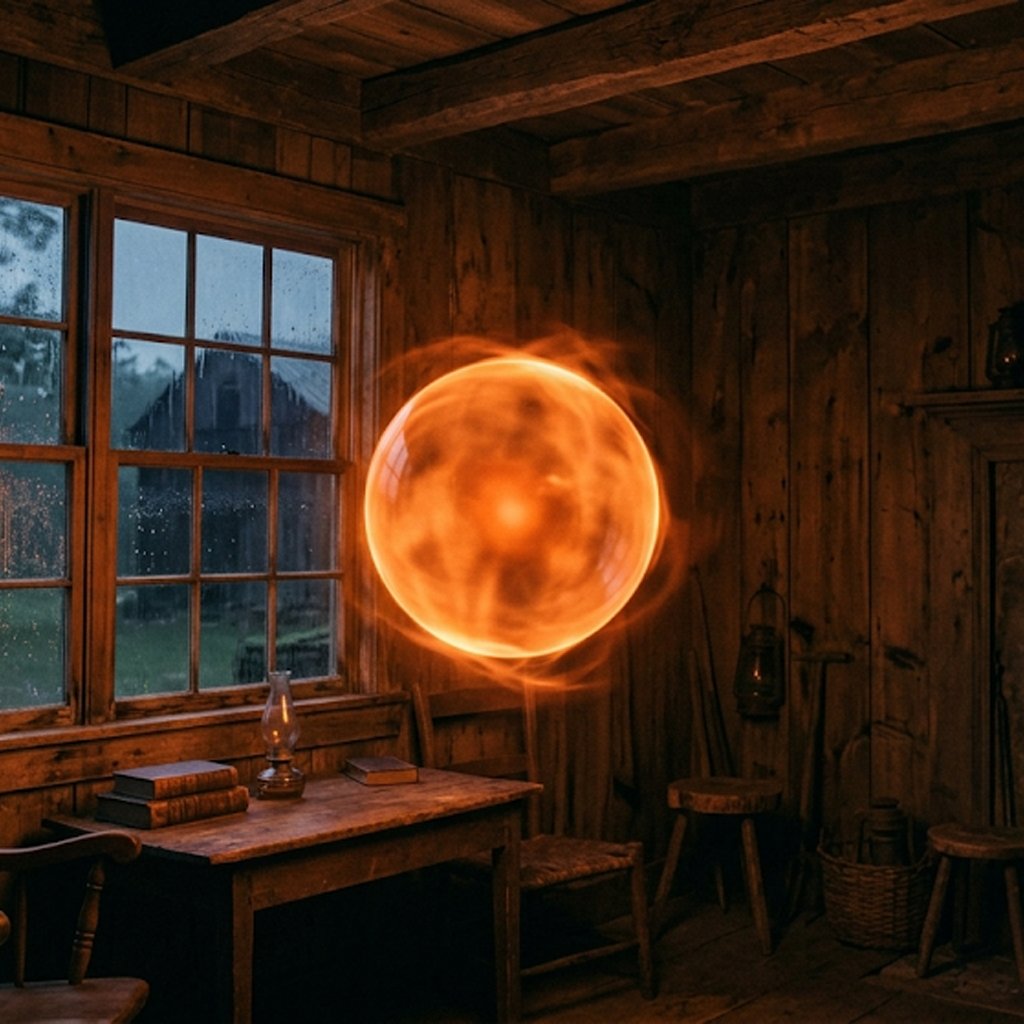
Ball lightning is the name for luminous spheres, usually reported from the size of a golf ball to a beach ball, that appear during or just after thunderstorms. Witnesses describe them drifting near the ground, floating through open windows or even walls, lasting from a second to a few seconds, and ending either silently or with a small explosion. Accounts go back centuries and come from sailors, farmers, and pilots, often people with no interest in the unusual [1].
Scientists treat the reports as describing a real phenomenon rather than pure invention, and the difficulty is not belief but study. Ball lightning is rare, brief, and unpredictable, so it almost never appears where instruments are ready. For most of its history the evidence was eyewitness testimony, which is why it stayed at the edge of atmospheric physics [1].
A leading explanation came in 2000, when John Abrahamson and James Dinniss proposed that when ordinary lightning strikes soil, it vaporizes silicon from minerals in the ground; the silicon condenses into a network of tiny particles that floats away and glows as it slowly burns in the air [2]. The idea gained major support in 2014, when Chinese researchers who were recording ordinary lightning happened to capture the spectrum of a natural ball-lightning event and found the elements of soil, silicon, iron, and calcium, in its light, which is what the vaporized-soil model predicts [3].
Not every case fits one cause, and some reports are likely misperceptions of related effects such as St. Elmo's fire, bright afterimages, or arcing electrical equipment [4]. Laboratory work has also produced glowing plasma balls with microwaves and electrical discharges that resemble the reports, though none yet reproduce the free-floating, long-lived object people describe. The mainstream position is that ball lightning is a genuine but poorly understood phenomenon, with the vaporized-soil model as the strongest current candidate rather than a closed case.
- [01] Stenhoff, M. (1999). Ball Lightning: An Unsolved Problem in Atmospheric Physics. Kluwer/Plenum.
- [02] Abrahamson, J. & Dinniss, J. (2000). Ball lightning caused by oxidation of nanoparticle networks. Nature 403, 519-521.
- [03] Cen, J., Yuan, P. & Xue, S. (2014). Observation of the Optical and Spectral Characteristics of Ball Lightning. Physical Review Letters 112, 035001.
- [04] Uman, M.A. (1987). The Lightning Discharge. Academic Press.
Because no single mechanism is settled, several other explanations remain in circulation. Each has a traceable origin and a documented response. They are laid out in full so you can weigh them yourself.
It requires exotic physics
Some early proposals reached for new physics, including a 1971 suggestion that ball lightning might be antimatter meteorites annihilating in the atmosphere [1]. The response: exotic ideas like antimatter or micro black holes predict effects, such as intense radiation, that reported ball lightning does not produce, and they are unnecessary once a chemical model explains the glow and the captured spectrum shows ordinary soil elements. Exotic physics is a solution in search of a problem the mundane models already handle.
It is a self-organized plasma we cannot yet sustain
A serious scientific line holds that ball lightning is a stable, self-contained plasma structure, and that the reason no theory is accepted is that we cannot yet make one last more than a moment in the lab [2]. This is a respectable position rather than a fringe one, and microwave and discharge experiments do produce short-lived glowing balls. Its limit is honest: no experiment has yet created a free-floating, seconds-long object matching the field reports, so the plasma model remains promising but unproven, sitting alongside the soil-chemistry model rather than replacing it.
It is mostly in the eye, not the air
At the skeptical end, some argue that many or most reports are not a physical object at all but magnetophosphenes, glowing shapes produced inside the eye and brain by the strong magnetic pulse of a nearby lightning strike [3]. This plausibly explains a share of cases, especially ones where the ball is seen through closed eyes or passes through solid walls. It struggles with reports of physical effects, singed surfaces, melted objects, multiple witnesses seeing the same shape, so it likely accounts for some sightings rather than all of them.
- [01] Ashby, D.E.T.F. & Whitehead, C. (1971). Is Ball Lightning Caused by Antimatter Meteorites? Nature 230, 180-182.
- [02] Ohtsuki, Y.H. & Ofuruton, H. (1991). Plasma fireballs formed by microwave interference. Nature 350, 139-141.
- [03] Cooray, G. & Cooray, V. (2008). On the possibility that all reports are magnetophosphenes. Journal of Atmospheric and Solar-Terrestrial Physics.
INFORMAL READER POLL, NOT DATA. WHICH EXPLANATION DO YOU FIND MOST CREDIBLE?