ANCIENT ASTRONAUTS
The claim that aliens visited early humans and helped build the pyramids, the Nazca lines, and other ancient wonders. Archaeologists say the builders needed no help, and the record shows how they did it.
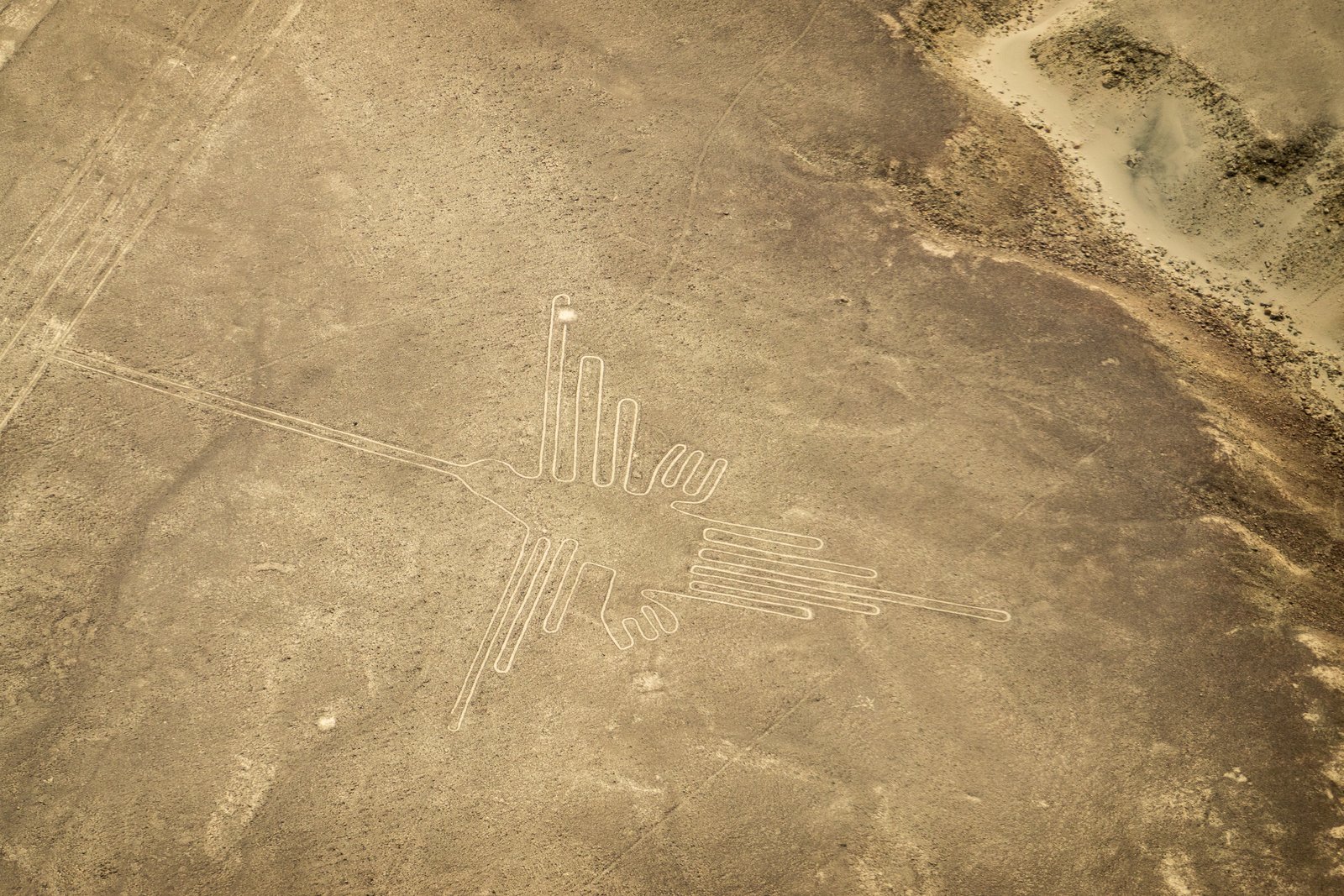

The ancient-astronaut idea holds that extraterrestrial visitors shaped early human history and helped build monuments such as the Egyptian pyramids, the Nazca lines of Peru, the stonework of Puma Punku, and the statues of Easter Island. It reached a mass audience through Erich von Daniken's 1968 book Chariots of the Gods and has been carried since by television, but its core premise runs against the archaeological record [1].
That premise is that ancient peoples could not have built their own monuments, and the evidence contradicts it at each site. The pyramids have quarries, unfinished blocks, workers' villages, tools, and records that show how they were cut, moved, and raised over years by organized labor. The Nazca lines were made by clearing dark surface stones to expose the pale ground beneath, a simple technique, and are laid out with stakes and cords in ways that leave archaeological traces; they read clearly from the surrounding foothills and needed no aerial viewer [4]. Easter Island's statues were carved from a known quarry and moved with ropes and human effort, which modern experiments have reproduced.
Specific "astronaut" images dissolve on inspection. The carved lid of the tomb of the Maya ruler Pakal, often shown as a man in a rocket, is a well-understood scene of the king at the world tree of Maya cosmology, read correctly through Maya art and glyphs [2]. Several of von Daniken's cited examples were shown to be exaggerated or fabricated by investigators in the 1970s [3].
Archaeologists also note a problem beyond the evidence. Attributing the achievements of Egyptian, Andean, and Polynesian peoples to aliens denies those cultures credit for their own engineering and labor, a pattern critics have called both unsupported and demeaning [1]. The mainstream position is not that every ancient question is solved, but that the monuments themselves are explained by human builders whose methods and remains are on the record.
- [01] Colavito, J. (2005). The Cult of Alien Gods. Prometheus Books.
- [02] Feder, K.L. (2020). Frauds, Myths, and Mysteries, 10th ed. Oxford University Press.
- [03] Story, R. (1976). The Space Gods Revealed: A Close Look at the Theories of Erich von Daniken. Harper & Row.
- [04] Aveni, A.F. (2000). Between the Lines: The Mystery of the Giant Ground Drawings of Ancient Nasca, Peru. University of Texas Press.
The claim survives in several forms, from full alien contact to a lost human past. Each has a traceable origin and a documented response. They are laid out in full so you can weigh them yourself.
Genuine extraterrestrial contact
The original version, from von Daniken, holds that visitors gave ancient peoples knowledge and technology recorded in myth and monument [1]. The response: no artifact of non-human origin has ever been recovered at any of these sites, the "evidence" is images reinterpreted against their own cultural meaning, and the monuments have documented human construction methods. A myth of sky beings is common to many cultures and is explained by religion and astronomy without requiring real visitors.
A lost advanced human civilization
A popular reworking, associated with Graham Hancock, drops the aliens and proposes a forgotten advanced human culture, destroyed in a cataclysm, that seeded later civilizations [2]. This is harder to dismiss than the alien version because it stays within humans, and it draws on real debates about early dates and sea-level change. Its weakness is the same absence of physical remains: an advanced worldwide culture would leave tools, metallurgy, and settlements, and none matching the claim have been found, while the known cultures show gradual local development rather than inheritance from a vanished teacher.
Specific sites still defy known methods
The most limited claim sets the grand theories aside and argues that a few sites, such as the precision joints of Puma Punku or the largest cut stones at Baalbek, exceed what their builders could plausibly do. This is the strongest entry point, because those sites are genuinely impressive. It falls short as proof because experimental archaeology has reproduced comparable stonework with period tools and abundant labor, and an unusually hard engineering problem is not the same as an impossible one. The gap is in our reconstruction of methods, not necessarily in the builders.
- [01] von Daniken, E. (1968). Chariots of the Gods. Econ-Verlag. The founding text of the modern claim.
- [02] Hancock, G. (1995). Fingerprints of the Gods. Crown. The lost-civilization variant.
- [03] Childress, D.H. (2000). Technology of the Gods. Adventures Unlimited Press. On alleged site anomalies.